How to Make Big and Bulky Last-Mile Work For You
Hats off to you for always wanting to make life…
Hats off to you for always wanting to make life…
You’ve sent your product out for delivery, they’ve received it,…
In the fast-evolving landscape of global trade and e-commerce, supply…
Following its success with Prime delivery and becoming the business…
This comprehensive guide dives into the world of eCommerce fulfillment, comparing Amazon FBA and dropshipping models. We’ll explore the advantages and challenges of each strategy, helping you make an informed decision for your business. MacMillan Supply Chain Group offers expert insights on optimizing your chosen fulfillment method, addressing common pain points, and maximizing efficiency. Whether you’re a startup or an established brand, this article provides valuable information on inventory management, customer service, and profit optimization. Discover how partnering with MacMillan can transform your eCommerce operations and drive sustainable growth in today’s competitive marketplace.
In the ever-evolving landscape of eCommerce, choosing the right fulfillment strategy can make or break your business. Two popular models that often come head-to-head are Amazon FBA (Fulfillment by Amazon) and dropshipping. Each offers unique advantages and presents its own set of challenges, leaving many entrepreneurs wondering which path to take.
This article aims to demystify these fulfillment methods, providing a detailed comparison of Amazon FBA and dropshipping. We’ll delve into the intricacies of each model, exploring their impact on inventory management, customer service, profit margins, and scalability. By understanding the nuances of these strategies, you’ll be better equipped to make a decision that aligns with your business goals and resources.
Furthermore, we’ll discuss how MacMillan Supply Chain Group can help you navigate the complexities of eCommerce fulfillment, offering tailored solutions to optimize your chosen strategy and overcome common obstacles in the industry.
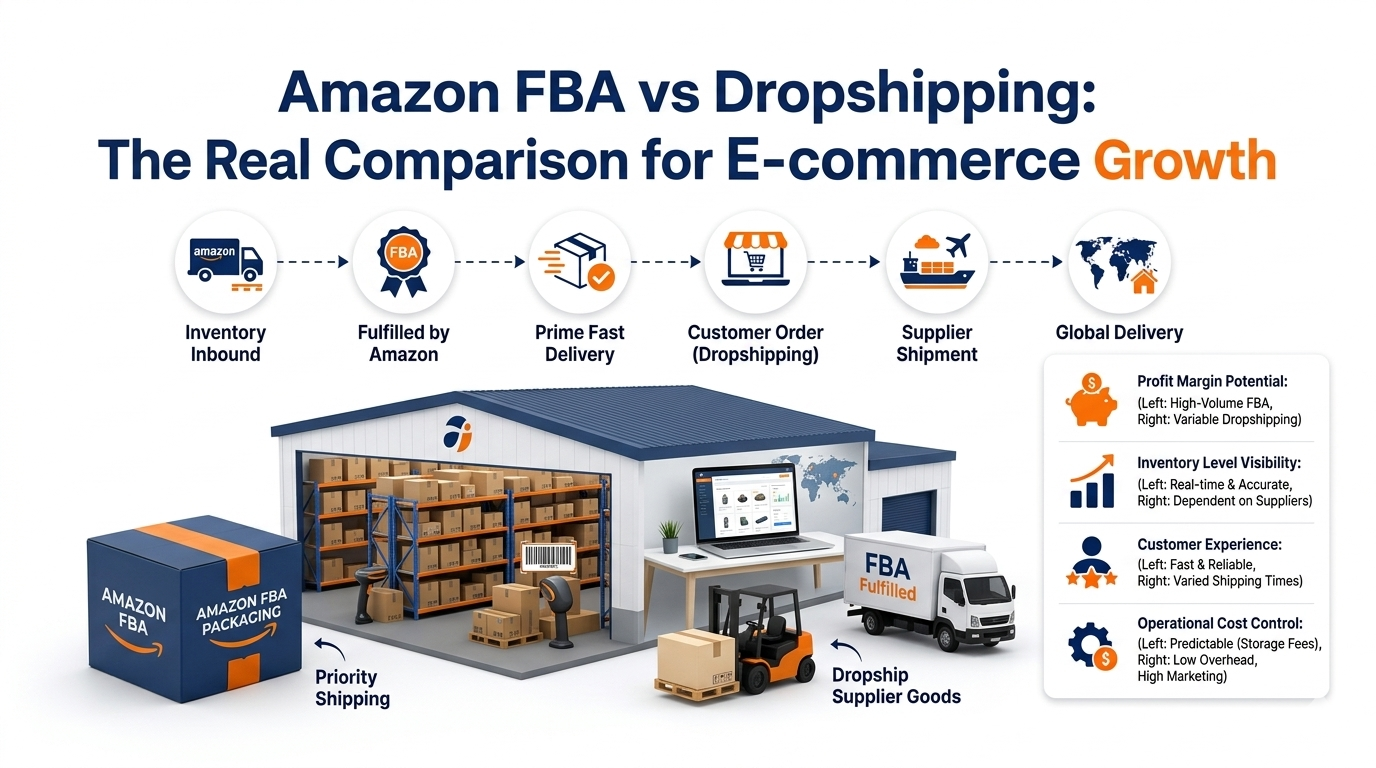
Amazon FBA has revolutionized eCommerce fulfillment by allowing sellers to tap into Amazon’s vast logistics network. When you choose FBA, you’re essentially partnering with one of the world’s most efficient fulfillment systems. Here’s how it works:
The primary advantage of FBA is the ability to offer Prime shipping, which can significantly boost your sales. Amazon’s brand trust and efficient delivery system can lead to higher customer satisfaction and repeat purchases. Additionally, FBA can save you time and resources on logistics, allowing you to focus on product development and marketing.
However, FBA isn’t without its challenges. The costs associated with storage fees, especially during slow seasons, can eat into your profits. There’s also intense competition on the Amazon marketplace, requiring strategic pricing and marketing efforts to stand out. Moreover, you’ll need to adhere to Amazon’s strict guidelines and policies, which can be restrictive for some businesses.
Despite these challenges, FBA remains a popular choice for sellers looking to leverage Amazon’s infrastructure and customer base to scale their eCommerce operations rapidly.
Dropshipping has gained popularity as a low-barrier entry point into eCommerce. This model allows you to sell products without holding inventory. Here’s the basic process:
The most significant advantage of dropshipping is its low initial investment. You don’t need to purchase inventory upfront, reducing financial risk. This model also offers great flexibility in terms of product selection and the ability to test new markets quickly. Dropshipping can be an excellent way to start an eCommerce business or expand an existing product line without significant capital outlay.
However, dropshipping comes with its own set of challenges. Profit margins are typically lower due to higher per-unit costs from suppliers. You have less control over inventory and shipping times, which can lead to customer service issues. There’s also significant competition in popular dropshipping niches, making it crucial to find unique products or add value through exceptional marketing and customer service.
Despite these challenges, dropshipping remains an attractive option for entrepreneurs looking to start an eCommerce business with minimal upfront costs and maximum flexibility.
When it comes to profit margins and scalability, Amazon FBA and dropshipping offer different advantages:
In terms of scalability, Amazon FBA has a clear advantage. As your sales volume increases, Amazon’s robust infrastructure can easily accommodate growth without requiring significant changes to your operations. However, this scalability comes at a cost, both in terms of fees and the need to maintain higher inventory levels.
Dropshipping offers more flexibility in scaling product offerings, but scaling operations can be more challenging. As your business grows, you may face issues with supplier reliability, inventory management across multiple suppliers, and maintaining consistent quality control.
Ultimately, the choice between these models depends on your business goals, available capital, and willingness to manage different aspects of the fulfillment process. Some businesses even opt for a hybrid approach, using both models to maximize their advantages.
Customer service and brand control are crucial factors in eCommerce success. Let’s compare how Amazon FBA and dropshipping stack up in these areas:
With Amazon FBA, you benefit from Amazon’s world-class customer service infrastructure. This can be a significant advantage, especially for small businesses that may struggle to provide 24/7 support. However, this comes at the cost of direct customer relationships and brand control.
Dropshipping allows for greater control over your brand identity and customer interactions. You can create a unique unboxing experience, personalize communication, and build direct relationships with your customers. However, this also means you’re responsible for handling all customer service issues, which can be time-consuming and challenging, especially when dealing with shipping delays or quality control problems.
Your choice between these models should consider your capacity for customer service management and the importance of brand control in your business strategy.
Both Amazon FBA and dropshipping present unique challenges that can hinder eCommerce success. At MacMillan Supply Chain Group, we’ve developed comprehensive solutions to address these common problems:
Problem: FBA sellers often struggle with optimizing inventory levels, leading to stockouts or excess storage fees. Dropshippers face issues with supplier inventory accuracy and synchronization.
Solution: MacMillan offers advanced inventory forecasting and management systems. We use data analytics to predict demand, optimize reorder points, and balance inventory across multiple channels. For dropshippers, we provide real-time inventory sync solutions and supplier performance monitoring.
Problem: FBA sellers may face issues with product damage during shipping to Amazon warehouses. Dropshippers often struggle with inconsistent product quality from suppliers.
Solution: Our quality assurance team implements rigorous inspection processes for FBA inventory before shipment to Amazon. For dropshipping, we help vet and manage supplier relationships, ensuring consistent quality standards.
Problem: FBA sellers may experience delays during peak seasons. Dropshippers often face longer and unpredictable shipping times.
Solution: MacMillan offers strategic warehouse locations and optimized shipping routes to minimize FBA transfer times. For dropshipping, we help implement order routing algorithms to select the fastest shipping options and provide accurate delivery estimates.
Problem: FBA fees can significantly impact profitability. Dropshippers struggle with thin margins due to supplier costs.
Solution: Our cost optimization strategies include SKU rationalization for FBA to minimize storage fees and bulk shipping to reduce inbound costs. For dropshipping, we negotiate better rates with suppliers and optimize order processing to reduce operational costs.
Problem: FBA limits direct customer interaction. Dropshippers struggle to create a cohesive brand experience.
Solution: MacMillan helps implement custom packaging solutions for FBA products to enhance brand recognition. For dropshipping, we offer white-label fulfillment services and assist in creating branded customer communication strategies.
Problem: Sellers using both FBA and dropshipping struggle to maintain consistent inventory and pricing across channels.
Solution: Our integrated multi-channel management platform provides a centralized system for inventory, order processing, and pricing across all sales channels, ensuring consistency and efficiency.
Problem: FBA returns can be costly. Dropshippers face challenges in managing returns across multiple suppliers.
Solution: MacMillan offers a centralized returns management system, optimizing the returns process for FBA to minimize costs. For dropshipping, we implement a streamlined returns process and provide customer service support to enhance the overall customer experience.
By addressing these common problems, MacMillan Supply Chain Group enables eCommerce businesses to optimize their operations, regardless of their chosen fulfillment model. Our tailored solutions help maximize efficiency, reduce costs, and improve customer satisfaction, ultimately driving sustainable growth in the competitive eCommerce landscape.
To avoid common pitfalls and optimize your eCommerce fulfillment strategy, consider the following steps:
However, navigating the complexities of eCommerce fulfillment can be challenging, especially as your business grows. This is where partnering with MacMillan Supply Chain Group can make a significant difference. Our team of experts can provide tailored solutions to optimize your fulfillment strategy, whether you’re using Amazon FBA, dropshipping, or a combination of both.
Don’t let fulfillment challenges hold your business back. Contact MacMillan Supply Chain Group today for a free consultation and discover how we can help streamline your operations, reduce costs, and drive growth in your eCommerce business.
Both can be suitable for beginners, depending on your resources and goals. Dropshipping typically requires less upfront investment, while FBA can offer quicker scalability. MacMillan can help you assess which model aligns best with your business objectives.
Managing inventory across multiple sales channels requires real-time visibility and accurate forecasting. Use inventory management software that syncs stock levels automatically across platforms like Amazon, Shopify, and WooCommerce. Regularly monitor sales trends, maintain safety stock, and work with reliable fulfillment partners to avoid overselling or stock shortages.
Amazon FBA costs typically include storage fees, fulfillment fees, referral fees, inbound shipping costs, and long-term storage charges. Additional costs may arise from returns processing, packaging requirements, and advertising campaigns needed to stay competitive on the Amazon marketplace.
To maintain product quality in dropshipping, partner with reputable suppliers and order sample products before selling them. Regular supplier evaluations, customer feedback monitoring, and clear quality standards can help ensure consistency. Working with third-party quality inspection services can also reduce product-related issues.
Yes, many businesses successfully use a hybrid model that combines Amazon FBA and dropshipping. FBA works well for high-demand products that require fast shipping, while dropshipping is ideal for testing new products with minimal risk. Combining both models can improve flexibility and scalability.
Create a clear return policy and communicate it to customers before purchase. Coordinate closely with suppliers to establish a streamlined returns process and ensure customers receive timely updates. Using centralized return management systems can also help simplify tracking and customer support.
The best way to scale an eCommerce business is by optimizing operations, automating repetitive tasks, and investing in reliable fulfillment solutions. Focus on improving customer experience, expanding product offerings strategically, and using data analytics to make informed business decisions.
You can improve dropshipping profit margins by negotiating better supplier pricing, reducing operational costs, and focusing on higher-value niche products. Improving branding, increasing average order value, and optimizing shipping costs can also help maximize profitability.
Important eCommerce fulfillment metrics include order accuracy rate, shipping time, inventory turnover, return rate, fulfillment cost per order, customer satisfaction score, and stockout frequency. Tracking these metrics helps identify inefficiencies and improve overall operational performance.
MacMillan Supply Chain Group can help optimize your eCommerce fulfillment strategy through warehousing, transportation, inventory management, shipping optimization, and supply chain solutions. Their tailored logistics services help businesses reduce costs, improve delivery efficiency, and scale operations more effectively.