Unlocking Supply Chain Transparency with Blockchain Technology
Quick Summary Imagine a world where every product’s journey from…

Quick Summary Imagine a world where every product’s journey from…
Quick Summary: As we approach 2025, the ocean freight industry…
Quick Summary What began as a grocery store experiment in…
Quick Overview In 2025, logistics will be transformed by automation,…
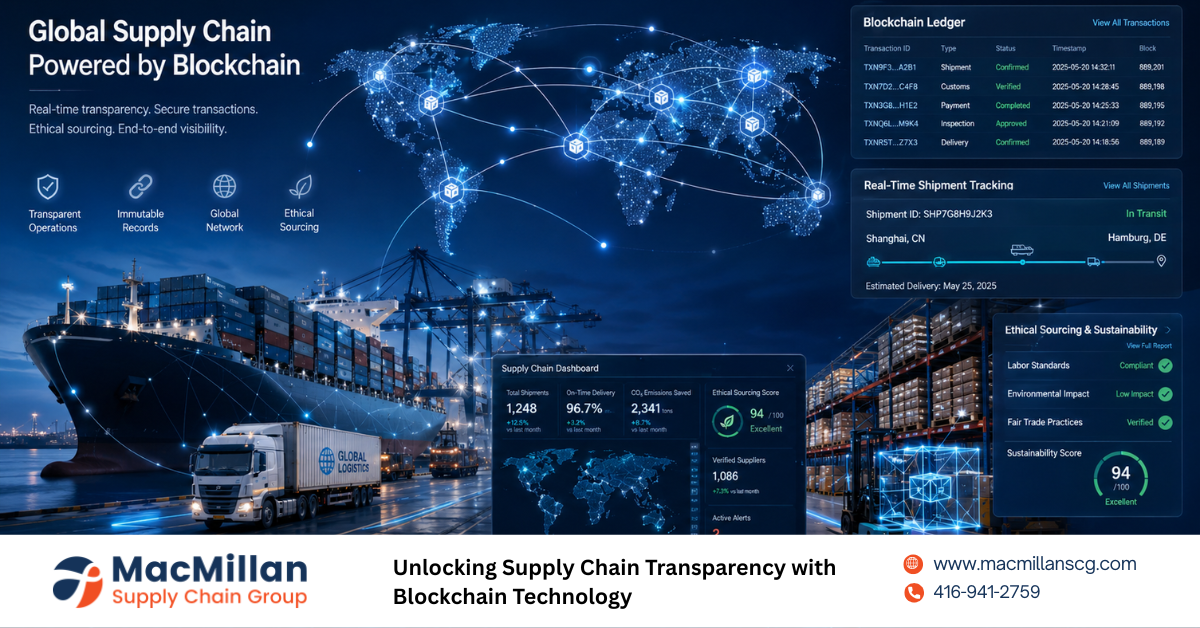
Imagine a world where every product’s journey from raw materials to your doorstep is as transparent as a glass jar. That’s the promise of blockchain technology. By creating an unbreakable digital ledger, it’s rewriting supply chain rules: eliminating fraud, automating contracts, and proving ethical sourcing. And no, this isn’t sci-fi. Companies like Nestlé and Walmart are already using it to track food safety. Ready to join them?
In an era where counterfeit goods cost the global economy $500 billion annually, and 66% of consumers demand ethical sourcing, supply chains can’t afford guesswork. Blockchain steps in as the ultimate truth-teller. At MacMillan supply chain transparency, we help businesses harness this technology to turn opacity into opportunity solving compliance headaches, speeding up transactions, and earning customer trust.
Think of blockchain as a digital notary. Every transaction shipments, quality checks, payments is stamped into a shared, unchangeable ledger.
“With blockchain, recalls that once took weeks now take minutes.” – MacMillan Supply Chain Case Study
What’s smarter than a contract? One that enforces itself.
Why it matters: Fewer delays, happier customers, and teams freed from chasing invoices
Blockchain doesn’t just store data—it guards it.
MacMillan Insight: Compliance isn’t a cost it’s your reputation’s insurance policy.
Consumers don’t just want “organic” labels they want proof. Blockchain delivers:
Your move: Turn sustainability claims into irrefutable stories.
Blockchain isn’t plug-and-play… yet. Common hurdles include:
Next Step: Book a free blockchain readiness assessment. Let’s map your leap from legacy to leading-edge.
Blockchain isn’t just for crypto enthusiasts. It’s the trust engine modern supply chain transparency need to thrive in a skeptical world. And with MacMillan? You’re not just adopting tech you’re future-proofing your reputation.
If you’re ready to enhance your supply chain transparency with blockchain technology, partner with MacMillan Supply Chain for unparalleled expertise and support. Our team will guide you through the implementation process, ensuring a seamless transition and maximizing the benefits of blockchain for your business. Contact us today to unlock the full potential of blockchain in your operations.
The primary benefit is enhanced transparency, with all transactions recorded in a decentralized, immutable ledger. This provides real-time visibility and traceability throughout the supply chain.
Blockchain improves supply chain visibility by creating a transparent and shared digital ledger where every transaction, shipment update, and quality check is recorded in real time. This allows businesses to track products from raw materials to final delivery with greater accuracy and accountability.
Yes, blockchain helps prevent counterfeiting by providing tamper-proof product records and authentication data. Brands can verify product origins, serial numbers, and ownership history, making it easier to identify fake or unauthorized goods in the supply chain.
Blockchain increases supply chain efficiency by automating processes, reducing paperwork, and improving data accuracy. Smart contracts can trigger payments, approvals, or shipment updates automatically, helping businesses minimize delays and operational errors.
Blockchain can benefit many industries including retail, healthcare, food, manufacturing, and logistics. However, the level of implementation depends on business size, operational complexity, regulatory requirements, and supply chain needs.
Data stored on a blockchain is highly secure because records are encrypted and distributed across multiple network nodes. Once information is added, it cannot be changed without network validation, making unauthorized alterations extremely difficult.
Yes, blockchain helps companies verify ethical and sustainable sourcing by tracking materials and suppliers throughout the supply chain. Businesses can provide transparent proof of fair trade practices, environmental compliance, and responsible sourcing.
Smart contracts automate agreements between parties in the supply chain. They execute actions such as payments, approvals, or order confirmations automatically when predefined conditions are met, improving speed, trust, and operational efficiency.
Blockchain strengthens supplier and buyer relationships by improving transparency, trust, and communication. Both parties gain access to accurate real-time data, reducing disputes, improving collaboration, and increasing accountability across the supply chain.
Yes, some common challenges include integration with legacy systems, implementation costs, scalability concerns, and evolving regulations. Businesses may also require employee training and technical expertise to fully adopt blockchain solutions successfully.