
Is Your Fulfillment Ready for AI Shopping in Canada?
A shopper asks an AI assistant to find a fragrance-free…

A shopper asks an AI assistant to find a fragrance-free…
As an online store business owner, offering the best customer…
The logistics industry in Canada is growing at an impressive…
In today’s competitive business landscape, staying ahead of the curve…
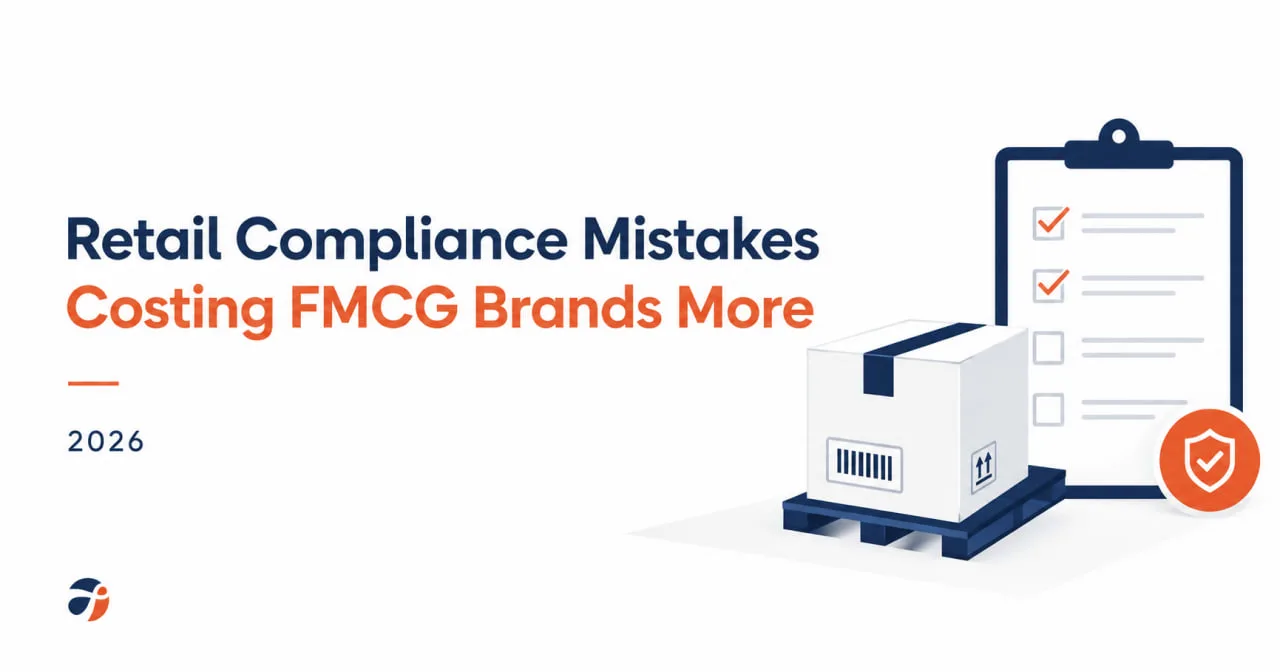
Retail compliance is no longer a back-office issue. For FMCG brands, it directly affects margin, retailer relationships, speed to shelf, and operational efficiency. When shipments arrive with labeling errors, incorrect pallet configuration, inaccurate ASNs, or retailer-specific packaging issues, the result is often the same: chargebacks, rejected deliveries, missed launch windows, and extra handling costs.
This topic is highly aligned with MacMillan SCG’s positioning. MacMillan’s services emphasize retailer-specific requirements including pallet height, label requirements, carton orientation, and ASN accuracy, all aimed at reducing chargebacks and delivery rejections. Its warehousing, value-added services, integrations, and transportation capabilities are built around retail-ready execution for FMCG brands.
For brands selling into retail in 2026, compliance mistakes are more expensive because retailer expectations are tighter, execution windows are smaller, and omnichannel pressure leaves less room for error. The brands that perform best are the ones that treat compliance as part of fulfillment strategy, not just documentation.
For FMCG brands, retail growth depends on more than product demand. It depends on execution.
A retailer may approve your product, issue the purchase order, and confirm the delivery slot, but that does not mean your inventory is ready to move cleanly into the network. If the ASN is wrong, the pallet does not match routing requirements, the barcode is unreadable, or the carton labeling is off, the shipment can still trigger costly consequences.
Those consequences are bigger than many brands realize. Retail compliance mistakes can create direct chargebacks, delayed receiving, delivery rejections, additional rework, labor costs, missed shelf placement, and damaged retailer trust. MacMillan explicitly positions its warehousing and value-added operations around helping brands meet retailer requirements and avoid these avoidable costs.
In 2026, that problem matters even more because brands are under pressure to support retail, ecommerce, marketplace, and promotional channels at the same time. Small execution mistakes now ripple faster across the entire supply chain.
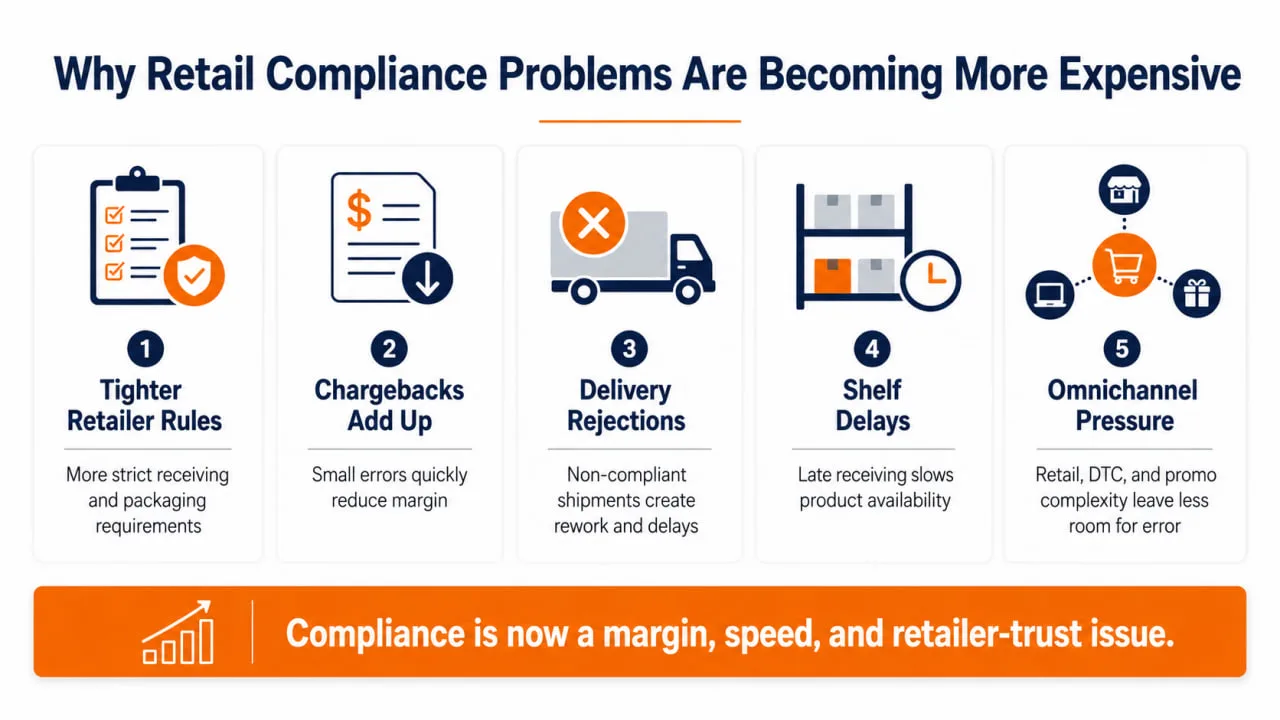
Retail compliance issues have always created friction, but the cost profile is growing because the modern FMCG supply chain is less forgiving.
Brands now face:
When inventory misses compliance requirements, the cost is no longer limited to one shipment. It can affect launch timing, shelf availability, retailer scorecards, replenishment flow, and future buying confidence.
MacMillan’s site reflects exactly this environment. Its transportation services are positioned around just-in-time deliveries, promotional drops, and strict retail DC schedules, while its warehousing services stress retailer compliance, rapid replenishment, and retail-ready preparation.
Most compliance failures are not dramatic. They are operational details that seem minor until the shipment reaches the retailer.
The most common mistakes include:
MacMillan specifically highlights support for pallet height requirements, label requirements, carton orientation, ASN accuracy, bilingual packaging, GS1 barcodes, promotional packaging, and retailer-ready display assembly. That makes this topic especially relevant to MacMillan’s audience and service mix.
One of the most immediate consequences is retailer chargebacks. These deductions can quietly erode margin shipment after shipment.
When brands focus only on freight cost or pick-pack cost, they often underestimate how much profitability leaks through preventable compliance deductions. A shipment that technically moved on time can still become unprofitable if it generates avoidable penalties.
MacMillan’s positioning directly addresses this by emphasizing retailer compliance support designed to reduce chargebacks and delivery rejections.
If a retailer rejects a shipment, the cost goes beyond the original move. The inventory may need to be rerouted, reworked, relabeled, rescheduled, or re-shipped. That means added transportation expense, warehouse labor, delay, and internal coordination.
This kind of failure is especially painful for promotional inventory or seasonal launches, where timing matters as much as product availability.
Even if a shipment is eventually accepted, compliance issues can delay receiving and shelf placement. For FMCG brands, speed matters. A late product launch or delayed replenishment does not just create inconvenience. It creates lost sell-through opportunity.
MacMillan positions its network around retail efficiency, launch readiness, and rapid replenishment support, which speaks directly to this problem.
Retailers want dependable execution. If your brand repeatedly creates receiving issues, scan failures, compliance deductions, or DC friction, it becomes harder to protect that relationship.
Operational inconsistency can affect how buyers, planners, and receiving teams view your brand. Over time, that can influence future opportunities even if the product itself performs well.
When compliance breaks down, commercial teams, operations teams, and customer service teams all get pulled into resolution mode. Instead of planning growth, they are chasing ASN corrections, retailer deductions, relabeling requests, and rescheduled deliveries.
That hidden labor cost adds up quickly.
FMCG brands operate in a category where velocity, precision, and retailer service levels matter every day.
Many also deal with:
MacMillan’s core messaging centers on helping FMCG brands avoid disruptions, reduce errors, maintain retailer service levels, and deliver with speed, visibility, and care. Its WMS-driven inventory visibility, lot and batch tracking, and KPI-led operations make retail compliance a natural content theme for the brand.
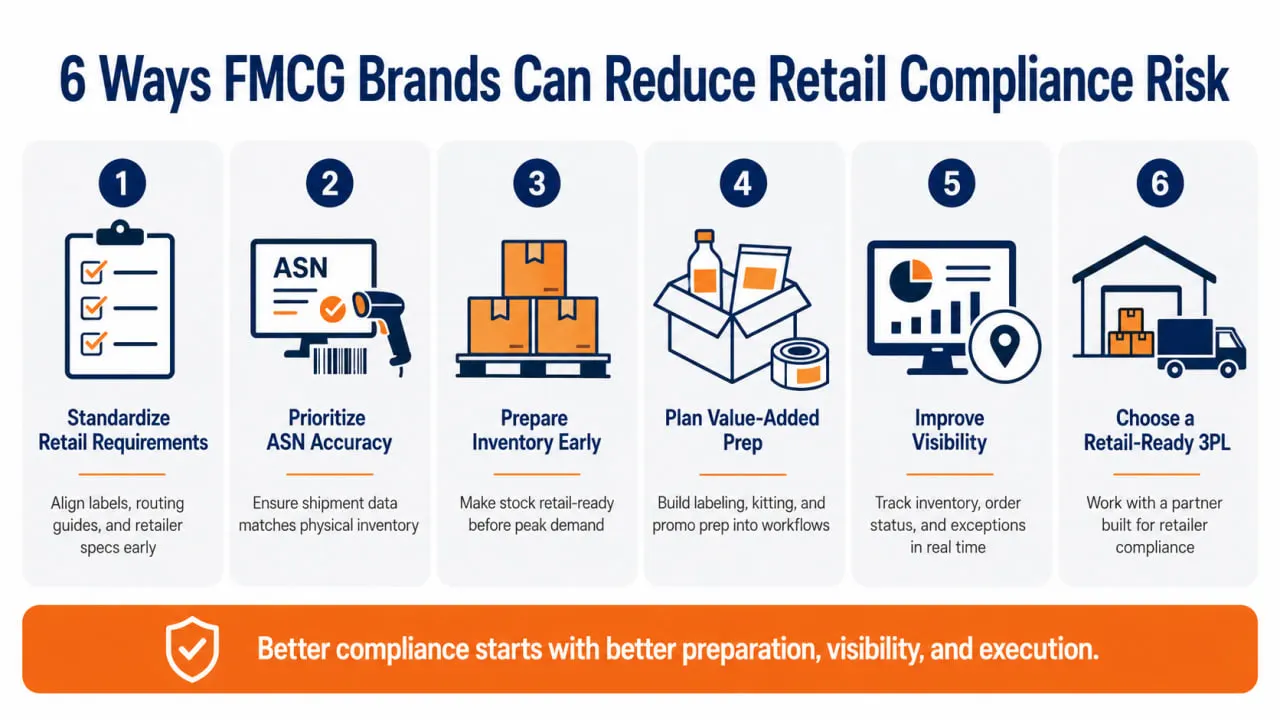
Do not wait until outbound staging to review retailer compliance requirements. Routing guides, label specs, pallet rules, ASN requirements, and booking processes should be built into workflows in advance.
ASN errors can create receiving friction even when the physical shipment is correct. Data accuracy matters as much as warehouse accuracy.
MacMillan explicitly calls out ASN accuracy as part of retailer-compliant warehousing execution.
Inventory should not just sit in storage waiting for orders. It should be staged, labeled, and prepared for retailer acceptance before promotional or replenishment pressure hits.
Kitting, relabeling, display assembly, bilingual packaging, and promo inserts should not be treated as last-minute add-ons. These are often the exact details that determine whether a shipment clears retail receiving smoothly.
MacMillan’s value-added services are built around these needs, including bilingual packaging, GS1 barcodes, promo labeling, reconfiguration, kitting, and display builds.
If teams cannot see what is allocated, what is prepared, what is delayed, and what is shipping, compliance issues surface too late.
MacMillan’s platform and services emphasize real-time order status, live tracking links, KPI visibility, milestone updates, and inventory access through its WMS-backed systems.
Not every warehouse is built for FMCG retail compliance. A launch-ready, retail-ready 3PL should understand DC requirements, promotional speed, ASN discipline, labeling precision, and delivery timing.
MacMillan’s site repeatedly positions the company around these specific strengths.
If any of these happen regularly, compliance is probably costing more than your team thinks:
A strong retail-compliance partner should offer:
MacMillan’s service stack maps directly to that requirement set through warehousing, transportation, integrations, value-added services, and KPI-led reporting.
MacMillan is well positioned to speak credibly on retail compliance because its site consistently emphasizes:
Its “Who We Serve” messaging also highlights expertise in compliance and retailer requirements to help CPG brands avoid costly penalties and meet retailer-specific mandates.
That makes this article not just SEO-friendly, but commercially aligned with what MacMillan already sells.
Retail compliance mistakes are expensive because they create more than deductions. They create friction across the entire supply chain.
For FMCG brands in 2026, that means lost margin, delayed shelf placement, extra labor, strained retailer relationships, and avoidable operational noise. The brands that reduce those costs are the ones that treat compliance as part of fulfillment execution from the start.
MacMillan SCG helps FMCG brands build retail-ready operations through compliant warehousing, value-added prep, ASN accuracy, retailer-specific execution, and transportation built for retailer precision. If your brand is dealing with chargebacks, delivery rejections, or recurring compliance issues, the right operational partner can turn those preventable losses into better performance.