
How Does a Supply Chain Firm Plan for High Demand?
With the right approach, supply chain planning can lower costs…

With the right approach, supply chain planning can lower costs…
Time-critical shipments can be defined in many ways. Critical shipping…

A shopper asks an AI assistant to find a fragrance-free…
As an online store business owner, offering the best customer…
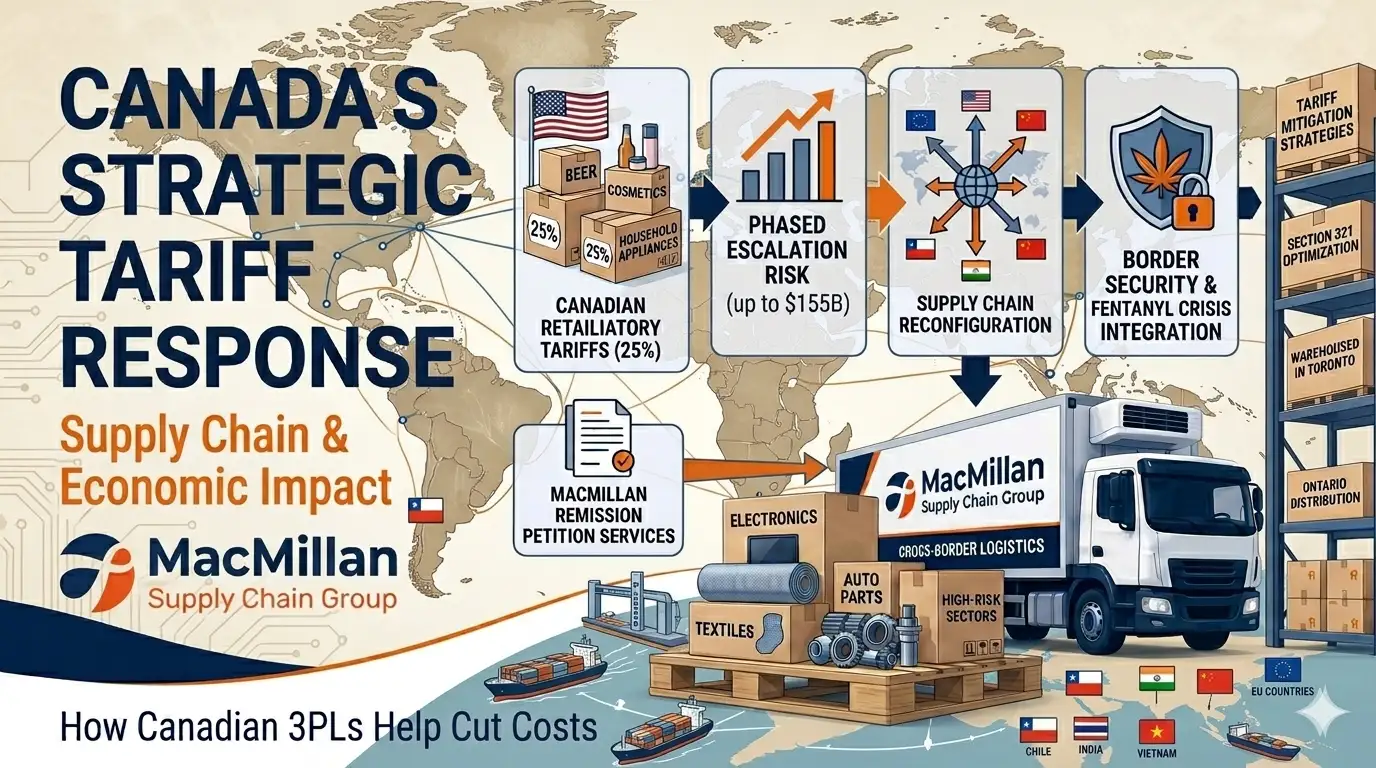
In a strong response to President Trump’s massive “reciprocal” tariffs, Canada announced 25% duties on $30 billion worth of American goods, which could rise to $155 billion if U.S. actions continue. Although economic factors like factory reshoring also play a part, border security issues particularly the fentanyl crisis are at the heart of this trade disagreement. The debate poses a threat to the USMCA pact, raises consumer prices, and disrupts supply networks. While maintaining diplomatic efforts to settle the conflict, both countries have put policies in place to safeguard their own sectors. Businesses conducting cross border trade in this unpredictable climate must understand these developments.
The United States-Canada trade relationship is currently dealing with its biggest obstacle in a long time. Citing border security and fentanyl trafficking fears, President Trump has placed new “reciprocal” tariffs on Canadian goods. Canada has responded by announcing a phased strategy of retaliatory tariffs that may eventually affect U.S. exports worth up to $155 billion.
Businesses on both sides of the border will be significantly impacted by this intensifying trade war. Decades-old supply networks are suddenly being disrupted, costs are increasing, and businesses need to quickly adjust to the new economic climate. The USMCA pact, which was designed to guarantee stable trade relations between the two countries, is also put to the test by this conflict.
For Canadian businesses and those engaged in US-Canada trade, understanding the scope, causes, and potential outcomes of this dispute is essential for strategic planning. Let’s examine the situation and its implications for your business operations.
There are two different stages to Canada’s reaction to Trump’s tariffs. About $30 billion worth of American goods are subject to 25% tariffs under the first phase, which is now in place. These initial retaliatory tariffs strategically target products with political significance in the U.S., including orange juice from Florida, beer from various states, household appliances, cosmetics, and pulp/paper products.
The careful choice of these Canada tariffs is what gives them their unique impact. Products that will generate pressure points in politically sensitive areas of the United States have been selected by the Canadian government. Targeting agricultural items, for instance, has an impact on farming communities, which frequently hold considerable political influence.
The mechanics of these tariffs are straightforward: when these American products cross the Canadian border, importers must pay an additional 25% tax.This raises the cost of U.S. goods for Canadian companies and consumers, which may lower demand and cause purchases to shift to domestic or other foreign providers.
Canada is willing to carry out a second round of retaliatory measures that would extend to cover up to $125 billion in more American goods if the U.S. keeps its tariffs in place. The economic impact of the trade conflict would be greatly increased by this second phase, which would target electronics, cattle, dairy goods, and electric vehicles.
The US-Canada trade relationship has historically been one of the world’s largest and most integrated. Bilateral commerce in goods and services was valued at over $800 billion in 2023. Because of this deep economic connectivity, tariffs have an impact on interconnected supply chains as well as individual items.
The current trade war poses several risks to this cooperation.. Initially, it upsets long-standing supply chains that span the border several times throughout manufacturing. For instance, before a vehicle is finished, auto parts may cross the border seven times. New levies could now be applied to every crossing, increasing expenses.
Second, companies preparing to expand or make investments are left in the dark by these interruptions. Businesses might put off making decisions until the trade environment calms down, which might hinder economic growth on both sides of the border.
Third, the disagreement calls into question the basic principles of the USMCA, which was created to offer a secure framework for commerce within the region. Canada argues that the U.S. tariffs violate this agreement by avoiding the established conflict resolution procedures. This undermines confidence in the North American trade deal.
These developments necessitate rapid attention to pricing strategies, supply chain resilience, and possible market diversification for companies involved in cross-border trade in order to reduce risks.
The way the United States has connected tariffs to border security issues, specifically fentanyl trafficking, is an unusual aspect of this trade war. The Trump administration asserts that the flow of illegal drugs into the United States is facilitated by Canada’s inadequate border security practices.
With thousands of American lives lost, the fentanyl pandemic is a powerful political issue. The U.S. administration has complicated what could otherwise be a simple commercial issue by linking trade policy to this public health disaster.
Canada has responded to these concerns by appointing Kevin Brosseau as a dedicated “fentanyl czar” to coordinate anti-trafficking efforts.In order to strengthen law enforcement’s ability to combat drug smuggling, the Canadian government has also labeled seven transnational criminal groups as terrorist entities.
However, Canadian officials dispute the American portrayal of the problem, pointing out that less than 1% of fentanyl entering the US goes via Canada. According to Canadian data, the majority of illegal fentanyl in the United States comes from Mexico or enters the country straight from China.
Because it shifts the conflict from typical economic negotiations to more extensive diplomatic and security cooperation, this security dimension makes efforts at resolution more difficult. This implies that for companies, the route to tariff removal can rely on advancements in fields unrelated to normal business concerns.
The Canadian government has put in place a number of support systems for industries impacted by both U.S. tariffs and Canada’s retaliatory actions in recognition of the possible harm to domestic companies.
The remission procedure, which enables Canadian businesses to ask for exemptions or relief from retaliatory tariffs if doing so would significantly damage their operations, is at the heart of this support. This procedure recognizes that certain companies are unable to locate substitute suppliers in a timely manner and rely significantly on U.S. inputs.
In addition to the remission process, the government has stated that it will use Crown corporations to offer financial assistance to companies who are having cash flow problems as a result of the tariffs. To help businesses weather the trade storm, this might involve direct financing, loan guarantees, or longer payment periods.
If trade disruptions lead to layoffs, workers in hard-hit sectors may be eligible for higher Employment Insurance benefits. If some industries see disproportionate effects, the government has stated that it is prepared to put sector-specific support programs into place.
The following Canadian industries are particularly at risk from the trade dispute:
Businesses and the overall economy face a number of serious difficulties as a result of the growing tariff conflict between the United States and Canada:
We at MacMillan Supply Chain Group have established all-encompassing plans to assist companies in overcoming the obstacles brought about by the tariff conflict between the United States and Canada. Both short-term operational issues and long-term strategic planning are addressed by our solutions:
We help companies analyze their current supply chains to identify vulnerabilities and opportunities for restructuring. Creating alternate sourcing plans for essential components Mapping whole supply networks to pinpoint tariff vulnerability locations are two examples of this.
To reduce the effects of tariffs, our customs and trade specialists offer specialized assistance:
We offer flexible warehousing solutions to address changing distribution needs:
Despite supply chain interruptions, our last-mile experience guarantees that items reach customers:
We collaborate with customers to update logistics agreements to reflect the following new realities:
Our sophisticated analytics tools assist companies in anticipating and adapting to shifting circumstances:
By implementing these solutions, we’ve helped clients maintain operational continuity while minimizing the financial impact of tariffs. Our comprehensive strategy solves current issues while setting up companies for long-term success in a changing trade environment.
Companies who are impacted by the tariff dispute between the United States and Canada can take a number of preventative measures to safeguard their business and set themselves up for future success. Here’s how to put these strategies into practice:
Do a thorough assessment of tariff exposure first. Examine your entire supply chain and product portfolio to determine whether items are directly impacted by Canadian or U.S. tariffs. Prioritize high-risk products for prompt action and calculate the possible financial effect.
Next, explore product re-engineering opportunities. In some cases, minor modifications to product specifications or country of origin can significantly alter tariff classification. Collaborate with product development teams to find potential alterations that might lower tariff liability without compromising the integrity of the final product.
Think about expanding your supplier network outside of North America. Starting this process now gives options in case the trade war lasts longer than expected, even though building new supplier connections takes time. To get the most flexibility, look for suppliers in nations that have free trade agreements with both the United States and Canada.
Examine your contracts and pricing plan right away. Ascertain which tariff expenses must be absorbed and which can be passed on to consumers. Look for provisions in long-term contracts that might permit renegotiation in response to material cost changes, such as tariffs.
Don’t face these obstacles by yourself. Access to specialist knowledge in supply chain optimization, international logistics, and customs compliance is made possible by working with a seasoned 3PL partner like MacMillan Supply Chain Group. Our staff is up to date on regulatory developments and can assist in putting solutions in place that are customized for your specific situation.
To discuss how MacMillan Supply Chain Group can assist your company in adjusting to the evolving trade environment, get in touch with us right now. Despite tariff difficulties, our integrated warehouse, distribution, and last-mile delivery services offer the adaptability and know-how required to preserve company continuity. Allow us to assist you in transforming this disruption into a chance to create a supply chain that is more robust and competitive.
Canada has implemented 25% tariffs on $30 billion worth of American goods, including orange juice, beer, appliances, and cosmetics. If U.S. tariffs continue, Canada plans to expand these measures to cover up to $155 billion in American exports, including electric vehicles, beef, and electronics.
Tariffs increase the cost of goods crossing the border, making imports more expensive for businesses and consumers. This disrupts long-established supply chains, slows down cross-border trade, and forces companies to reconsider sourcing and pricing strategies. It also creates uncertainty, which can delay investments and business expansion.
The United States has linked tariffs to border security concerns, particularly fentanyl trafficking. The U.S. government argues that stronger trade pressure will push Canada to improve border controls. However, Canada disputes this connection, stating that only a very small percentage of fentanyl enters the U.S. through its border.
The USMCA was designed to ensure stable and predictable trade between the U.S., Canada, and Mexico. However, Canada claims that the U.S. tariffs violate the agreement by bypassing established dispute resolution mechanisms. This puts the credibility and effectiveness of the trade pact at risk.
The Canadian government offers several support measures, including tariff remission programs (allowing businesses to request exemptions), financial assistance through Crown corporations, and potential sector-specific aid. Workers in affected industries may also receive enhanced Employment Insurance benefits if disruptions lead to layoffs.
Businesses can reduce impact by assessing tariff exposure, diversifying suppliers beyond North America, re-engineering products to lower tariff classifications, and renegotiating contracts. Partnering with experienced 3PL providers like MacMillan Supply Chain Group can also help optimize logistics, manage tariffs, and maintain supply chain efficiency.