
Post-Trump Trade Policies: Key Changes for Canadian Businesses | MacMillan Supply Chain
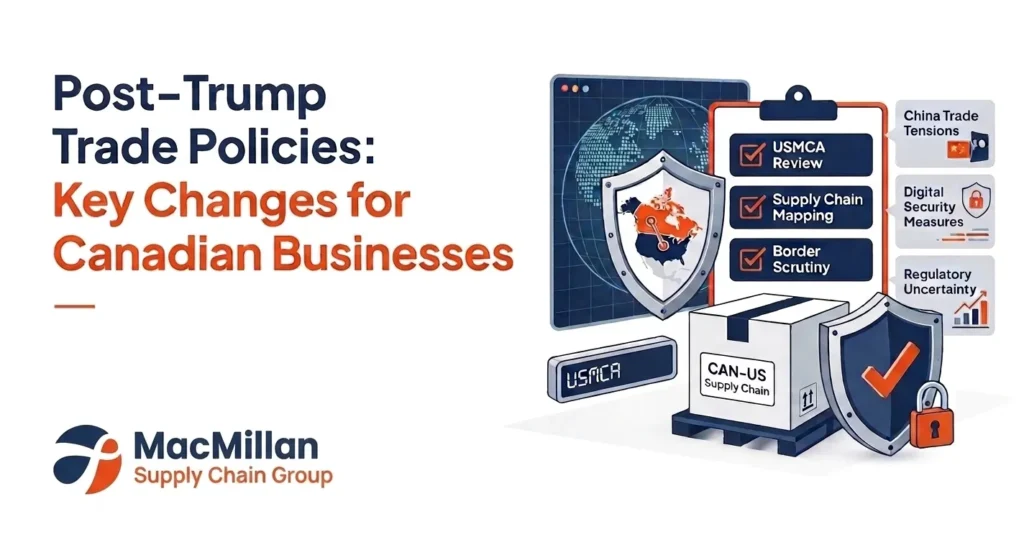
A Quick Summary and Overview The trade policies of the post-Trump era have instigated profound shifts in the relationship between Canada and the United States. There is now a much sharper focus on domestic manufacturing and national security. All of this raises serious questions about the future of cross-border supply chains and eventually even the very concept of free trade. The next major test for all of this is the USMCA (United States-Mexico-Canada Agreement) review in 2026. Even without any potential confounding issues that could arise between now and then, that review is already shaping up in my mind as a major possible inflection point in this relationship. Introduction Every day, nearly $2 billion in goods and services flow between the United States and Canada, making this one of the largest bilateral economic relationships in the world. But in recent years, trade policies have changed—varying by the week or by the day—creating uncertainty for companies on both sides of the border. For Canadian businesses, the switch in trade rules presents opportunities even as it poses challenges. What precisely has transformed in the trade environment, and what should your company be poised for? The evolution from a production-based economy to today’s—well, what exactly is today? And what will tomorrow be? Between heightened national security concerns, the forthcoming review of the new NAFTA (the USMCA), and our ongoing trade dispute with China, the trade landscape is shifting beneath our feet. For companies managing cross-border supply chains, these tectonic changes require not just attention but strategic adaptation. In this article, we’ll break down the key policy changes, explore their real world impact on Canadian businesses, and share practical strategies to navigate this new trade environment successfully. Understanding Post-Trump Trade Policies The current U.S. administration has maintained and expanded many trade approaches from the previous administration while adding new dimensions. At the core of post Trump trade policies is an emphasis on creating a production based economy that prioritizes North American manufacturing over imports from overseas markets. This shift manifests in several key ways that directly affect Canadian businesses: First, there’s a strong focus on reviewing and potentially renegotiating existing trade agreements. The USMCA (which replaced NAFTA) faces a mandated review in 2026, creating uncertainty about future trade terms. U.S. trade officials are already preparing for this review, examining how the agreement impacts American workers and industries. Second, trade decisions are now closely linked to national security considerations. This is especially noticeable in the technology sector, where cybersecurity and data privacy concerns have an impact on legislation. The impacts of the ongoing TikTok ban show how security issues can upend established supply chains and business models. Third, there’s increased enforcement of trade rules, with stricter monitoring of compliance across borders. Canadian exporters face more scrutiny regarding rules of origin, labor standards, and environmental practices. For businesses operating cross border supply chains, these policy shifts require careful monitoring and strategic planning. Companies that previously relied on predictable trade flows must now prepare for potential disruptions and compliance challenges. Working with experienced logistics partners like MacMillan Supply Chain Group can help businesses stay ahead of these changes and adapt their supply chain strategies accordingly. The Evolution of Canada-US Trade Relations The relationship between Canada and the U.S. has always been complex, balancing economic interdependence with national interests. Recent post-Trump trade policies have added new dimensions to this dynamic, requiring a fresh Canadian trade strategy. Historically, Canada has been America’s largest trading partner, with deeply integrated supply chains across numerous industries. However, this relationship has faced significant tests in recent years: The renegotiation of NAFTA into the USMCA brought stricter rules of origin requirements, particularly in the automotive sector. Canadian manufacturers now need to ensure higher North American content percentages to qualify for duty free treatment. This shift aligns with the production-based economy focus that continues to drive U.S. trade policy. Buy American provisions have expanded, creating challenges for Canadian companies selling to U.S. government entities. These policies prioritize U.S.-made products for government procurement, potentially limiting opportunities for Canadian exporters. Tariff threats remain a concern, with aluminum and steel sectors experiencing periodic uncertainty. Though many Section 232 tariffs have been resolved, the precedent creates ongoing risk for cross-border trade. Digital trade has emerged as a new frontier, with data security measures becoming increasingly important. Canadian businesses handling U.S. customer data must navigate evolving privacy regulations and security requirements. Despite these challenges, opportunities exist. The shared focus on reducing dependence on Chinese manufacturing has created openings for Canadian suppliers. Additionally, collaborative approaches to clean energy and critical minerals development present growth potential for Canadian exporters. For businesses navigating these changes, understanding the nuances of Canada-US trade relations is essential. MacMillan Supply Chain Group helps clients leverage these evolving dynamics by optimizing cross-border logistics and ensuring compliance with changing regulations. USMCA Review What It Means for Businesses The USMCA review scheduled for 2026 represents a pivotal moment for businesses operating across North American borders. This mandatory assessment could maintain the status quo or trigger significant changes to the agreement that governs nearly $1.5 trillion in annual trade. Key aspects of the USMCA review that businesses should monitor include: Labor provisions enforcement will likely intensify. The agreement’s labor chapter includes unprecedented protections for workers, and U.S. officials have already used the Rapid Response Labor Mechanism to investigate facilities in Mexico. Canadian businesses with operations or suppliers in Mexico should evaluate labor compliance proactively. Automotive rules of origin requirements could tighten further. The current 75% North American content threshold for duty free treatment might increase, pushing more manufacturing back to the continent. Supply chain mapping becomes essential to understand exposure to potential changes. Digital trade rules may evolve as technology advances. The USMCA was the first U.S. trade agreement with comprehensive digital trade provisions, but rapid technological change could necessitate updates to address emerging issues like AI and data security measures. Environmental standards enforcement will likely increase, with greater scrutiny of compliance across borders. Companies should document their environmental practices
How AI and Automation Are Changing FMCG Fulfillment in Canada
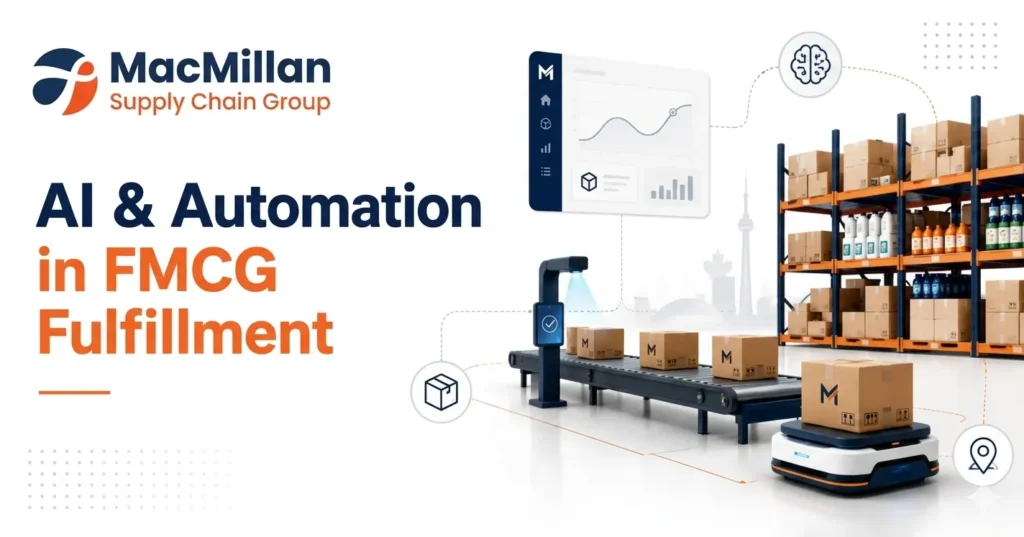
A Quick Summary and Overview AI and automation are changing FMCG fulfillment in Canada by helping brands improve inventory accuracy, forecast demand more effectively, reduce manual errors, speed up warehouse workflows, and respond faster to changing retail and consumer demand. Current industry coverage consistently highlights robotics, predictive analytics, dynamic routing, and smarter warehouse software as major fulfillment trends shaping 2025 and beyond. For MacMillan, this topic fits naturally. MacMillan already positions itself around data-driven visibility, WMS-powered control, AI-powered route optimization, real-time tracking, retailer-ready warehousing, and KPI-led fulfillment performance across Canada. Introduction FMCG fulfillment has always been a speed game, but now it is also a data game. Brands are expected to keep shelves full, support promotions, avoid stockouts, reduce waste, and deliver accurately across retail, ecommerce, and marketplace channels at the same time. That is exactly why AI and automation are becoming more important in Canadian fulfillment. They help operations move from reactive decisions to faster, more informed, more scalable execution. Current warehouse trend coverage points to AI-driven analytics, robotics, predictive maintenance, and workflow optimization as key shifts in modern fulfillment operations. For FMCG brands, this matters because even small delays or inaccuracies can quickly affect service levels, margins, and retailer relationships. MacMillan’s own positioning reflects this reality through its focus on inventory visibility, scan-verified fulfillment, real-time tracking, and retail-ready execution. Why This Topic Matters More Now AI and automation are not just future-facing topics anymore. They are becoming practical tools for brands trying to manage volatility, labor pressure, fulfillment speed, and inventory complexity. Recent reporting shows retailers and supply chain teams using AI to predict stockouts, improve inventory availability, and make faster replenishment decisions based on real-time demand signals. At the warehouse level, 2026 trend coverage points to several major shifts: greater use of robotics for repetitive movement and retrieval AI-powered demand and inventory planning dynamic routing and workflow optimization automated data capture for accuracy and visibility scalable systems that adapt to changing order volumes That combination is especially relevant in FMCG, where product velocity is high and the cost of delay is immediate. What AI and Automation Mean in FMCG Fulfillment In practical terms, AI and automation in fulfillment usually refer to systems that help operations make better decisions and complete repetitive tasks faster. That can include: AI-assisted demand forecasting warehouse management systems that optimize slotting and replenishment automated storage and retrieval systems AGVs or AMRs that move goods through facilities scan-based inventory control predictive alerts for delays, stockouts, or equipment issues route optimization and real-time delivery tracking The point is not to remove people from the operation. The real value is usually in helping teams work with more accuracy, more visibility, and less wasted motion. 6 Ways AI and Automation Are Changing FMCG Fulfillment in Canada 1. Better demand forecasting and replenishment AI helps fulfillment operations move beyond static planning. Recent reporting shows AI being used to analyze lead times, current inventory, and consumer demand so teams can identify likely shortages earlier and make faster replenishment decisions. For FMCG brands, that can mean: fewer stockouts during demand spikes better seasonal planning less excess inventory more confidence in replenishment timing MacMillan’s broader service positioning supports this approach through WMS-backed visibility, data-driven insights, and fulfillment systems designed to help brands reduce errors and improve inventory control. 2. Faster and more accurate warehouse operations Warehouse automation is becoming more common because it helps increase throughput while reducing manual handling errors. Current warehouse trend coverage highlights AS/RS systems, AGVs, and robotics as important tools for improving storage, retrieval, and order processing efficiency. For FMCG, that matters because fast-moving products need: quicker inbound processing faster pick-pack execution better inventory movement fewer errors in high-volume environments MacMillan already emphasizes scan-verified fulfillment, high inventory accuracy, rapid dock-to-stock execution, and operational precision in its service messaging. 3. Real-time visibility across inventory and orders AI is only as useful as the visibility around it. Modern fulfillment systems increasingly use real-time data to help teams understand what is in stock, what is moving, what is delayed, and where intervention is needed. Exotec’s 2025 trend coverage specifically points to AI systems that track SKU behavior, reassign product locations, and optimize workflows in real time. MacMillan’s site aligns strongly with this value proposition. It highlights real-time order status, live tracking, milestone updates, digital PODs, KPI reporting, and inventory visibility through its WMS-backed platform. 4. Smarter routing and transportation planning AI is not limited to the warehouse. It also improves transportation by optimizing routes, reducing delays, and increasing delivery predictability. MacMillan’s food and beverage page specifically highlights AI-powered route optimization and real-time delivery tracking, while its transportation services emphasize milestone visibility and retailer-precision execution. For FMCG brands, smarter transportation matters because: retailer delivery windows are strict replenishment timing affects shelf availability delays can increase spoilage, stockouts, or compliance risk last-mile visibility improves operational response 5. Lower manual error and stronger compliance execution Automation often improves performance by reducing repetitive manual steps that create fulfillment mistakes. Scan-based workflows, automated reconciliation, barcode support, and system-driven validation all help improve order accuracy and inventory reliability. MacMillan’s promises and service pages directly reference barcode and RFID support, real-time APIs, EDI and ASN support, and automated QC workflows. That is especially important in FMCG, where errors can lead to: retailer chargebacks delivery rejections inaccurate stock levels mis-picks during peak periods slower recall response where lot control matters 6. More scalable peak-season and launch execution Automation helps operations scale without relying only on manual expansion. Current warehouse trend coverage notes that robotics and workflow automation are increasingly valued because they support flexibility, speed, and operational resilience as demand changes. MacMillan’s own positioning mirrors this need. The company states that it tech-scales for promotions, seasonal spikes, and new product launches, and that its facilities support rapid pick-pack, labeling, shipping, and retail-ready prep for high-volume periods. What AI Still Cannot Replace Even with more automation, strong fulfillment still depends on execution, oversight, and responsiveness. AI can improve forecasting, routing, and workflow decisions, but FMCG brands still need:
Why Retail Compliance Mistakes Are Costing FMCG Brands More
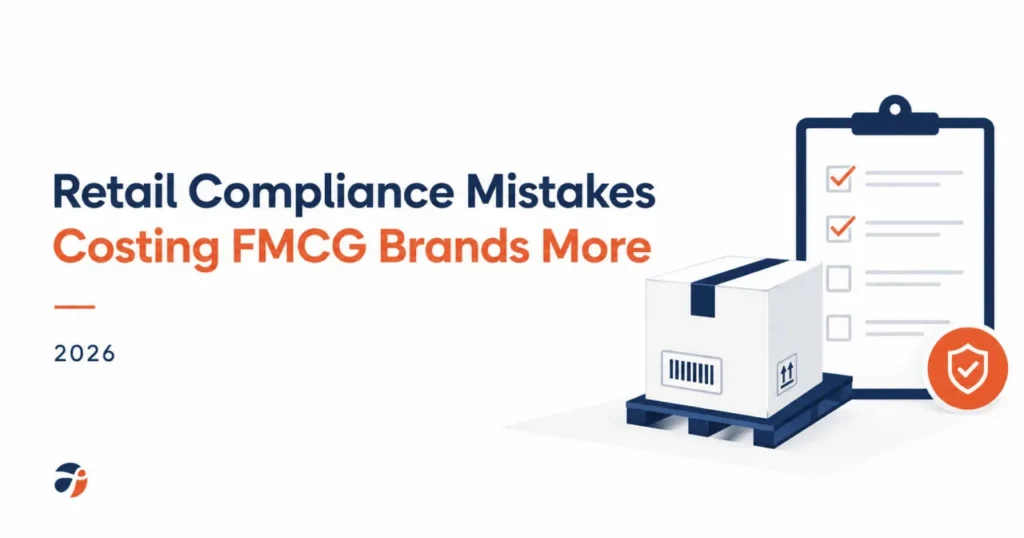
A Quick Summary and Overview Retail compliance is no longer a back-office issue. For FMCG brands, it directly affects margin, retailer relationships, speed to shelf, and operational efficiency. When shipments arrive with labeling errors, incorrect pallet configuration, inaccurate ASNs, or retailer-specific packaging issues, the result is often the same: chargebacks, rejected deliveries, missed launch windows, and extra handling costs. This topic is highly aligned with MacMillan SCG’s positioning. MacMillan’s services emphasize retailer-specific requirements including pallet height, label requirements, carton orientation, and ASN accuracy, all aimed at reducing chargebacks and delivery rejections. Its warehousing, value-added services, integrations, and transportation capabilities are built around retail-ready execution for FMCG brands. For brands selling into retail in 2026, compliance mistakes are more expensive because retailer expectations are tighter, execution windows are smaller, and omnichannel pressure leaves less room for error. The brands that perform best are the ones that treat compliance as part of fulfillment strategy, not just documentation. Introduction For FMCG brands, retail growth depends on more than product demand. It depends on execution. A retailer may approve your product, issue the purchase order, and confirm the delivery slot, but that does not mean your inventory is ready to move cleanly into the network. If the ASN is wrong, the pallet does not match routing requirements, the barcode is unreadable, or the carton labeling is off, the shipment can still trigger costly consequences. Those consequences are bigger than many brands realize. Retail compliance mistakes can create direct chargebacks, delayed receiving, delivery rejections, additional rework, labor costs, missed shelf placement, and damaged retailer trust. MacMillan explicitly positions its warehousing and value-added operations around helping brands meet retailer requirements and avoid these avoidable costs. In 2026, that problem matters even more because brands are under pressure to support retail, ecommerce, marketplace, and promotional channels at the same time. Small execution mistakes now ripple faster across the entire supply chain. Why Retail Compliance Problems Are Becoming More Expensive Retail compliance issues have always created friction, but the cost profile is growing because the modern FMCG supply chain is less forgiving. Brands now face: tighter retailer receiving rules faster replenishment expectations stricter ASN and EDI requirements more retailer-specific packaging and display demands less buffer inventory in fast-moving networks more pressure to support both retail and DTC at once When inventory misses compliance requirements, the cost is no longer limited to one shipment. It can affect launch timing, shelf availability, retailer scorecards, replenishment flow, and future buying confidence. MacMillan’s site reflects exactly this environment. Its transportation services are positioned around just-in-time deliveries, promotional drops, and strict retail DC schedules, while its warehousing services stress retailer compliance, rapid replenishment, and retail-ready preparation. What Retail Compliance Mistakes Usually Look Like Most compliance failures are not dramatic. They are operational details that seem minor until the shipment reaches the retailer. The most common mistakes include: incorrect or missing carton labels pallet builds that do not match retailer specs inaccurate ASN data non-compliant carton orientation poor barcode quality or scan failures incomplete retailer-specific packaging requirements missed routing guide instructions promo displays or bundles prepared incorrectly bilingual or channel-specific labeling errors inadequate lot, batch, or expiry visibility when required MacMillan specifically highlights support for pallet height requirements, label requirements, carton orientation, ASN accuracy, bilingual packaging, GS1 barcodes, promotional packaging, and retailer-ready display assembly. That makes this topic especially relevant to MacMillan’s audience and service mix. The Real Cost of Retail Compliance Mistakes 1. Chargebacks Reduce Margin Fast One of the most immediate consequences is retailer chargebacks. These deductions can quietly erode margin shipment after shipment. When brands focus only on freight cost or pick-pack cost, they often underestimate how much profitability leaks through preventable compliance deductions. A shipment that technically moved on time can still become unprofitable if it generates avoidable penalties. MacMillan’s positioning directly addresses this by emphasizing retailer compliance support designed to reduce chargebacks and delivery rejections. 2. Delivery Rejections Create Double Handling If a retailer rejects a shipment, the cost goes beyond the original move. The inventory may need to be rerouted, reworked, relabeled, rescheduled, or re-shipped. That means added transportation expense, warehouse labor, delay, and internal coordination. This kind of failure is especially painful for promotional inventory or seasonal launches, where timing matters as much as product availability. 3. Shelf Delays Hurt Sales Even if a shipment is eventually accepted, compliance issues can delay receiving and shelf placement. For FMCG brands, speed matters. A late product launch or delayed replenishment does not just create inconvenience. It creates lost sell-through opportunity. MacMillan positions its network around retail efficiency, launch readiness, and rapid replenishment support, which speaks directly to this problem. 4. Retailer Trust Becomes Harder to Win Back Retailers want dependable execution. If your brand repeatedly creates receiving issues, scan failures, compliance deductions, or DC friction, it becomes harder to protect that relationship. Operational inconsistency can affect how buyers, planners, and receiving teams view your brand. Over time, that can influence future opportunities even if the product itself performs well. 5. Internal Teams Spend Time Fixing Avoidable Problems When compliance breaks down, commercial teams, operations teams, and customer service teams all get pulled into resolution mode. Instead of planning growth, they are chasing ASN corrections, retailer deductions, relabeling requests, and rescheduled deliveries. That hidden labor cost adds up quickly. Why FMCG Brands Are Especially Exposed FMCG brands operate in a category where velocity, precision, and retailer service levels matter every day. Many also deal with: high SKU counts frequent promotions retail and DTC inventory overlap lot and batch requirements expiry sensitivity in some categories packaging variation by retailer or channel fast replenishment cycles MacMillan’s core messaging centers on helping FMCG brands avoid disruptions, reduce errors, maintain retailer service levels, and deliver with speed, visibility, and care. Its WMS-driven inventory visibility, lot and batch tracking, and KPI-led operations make retail compliance a natural content theme for the brand. 6 Ways FMCG Brands Can Reduce Retail Compliance Risk 1. Standardize Retail Requirements Before Inventory Ships Do not wait until outbound staging
Top 10 E-Commerce Warehousing Trends 2025 | MacMillan
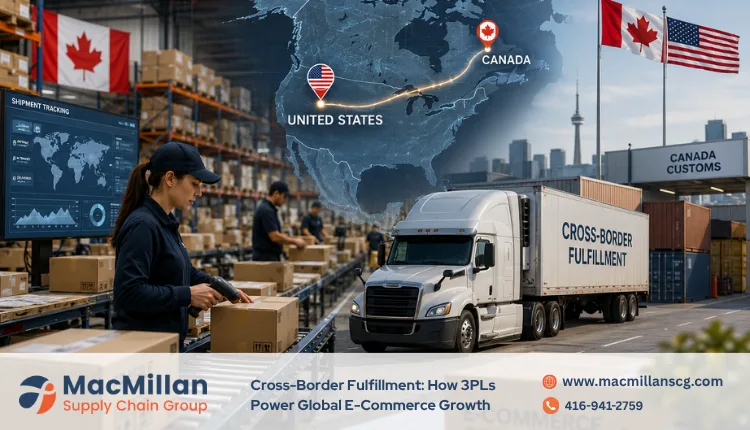
A Quick Summary and overview The e-commerce warehousing landscape is rapidly evolving with technological advancements reshaping how businesses handle inventory and fulfill orders. In 2025, we’ll see widespread adoption of AI automation, hyperlocal fulfillment centers, and IoT powered smart warehousing solutions. Sustainability initiatives, vertical storage systems, and blockchain technology are becoming essential components of modern warehousing operations. Companies embracing these trends will gain competitive advantages through improved efficiency, reduced costs, and enhanced customer experiences in an increasingly demanding marketplace. Introduction The e-commerce industry continues to experience explosive growth, with warehousing operations evolving at an unprecedented pace to meet rising consumer expectations. As we look toward 2025, businesses must adapt to new technologies and strategies to remain competitive in this dynamic landscape. The e-commerce warehousing trends in 2025 will focus on automation, sustainability, and customer centric solutions that streamline operations while reducing costs. For Canadian businesses especially, staying ahead of these trends is crucial as the country’s e-commerce market expands and cross-border trade increases. From AI-powered systems to hyperlocal delivery models, these innovations are reshaping how products move from warehouse shelves to customers’ doorsteps. Let’s explore the top 10 trends that will define e-commerce warehousing in 2025 and how they can transform your supply chain operations. AI and Automation Integration The biggest change in warehouse automation strategy for 2025 is the combination of automation and artificial intelligence. These technologies are now necessary for competitive warehousing operations and are no longer optional. Advanced AI systems now handle complex decision-making processes that previously required human intervention. Predictive analytics algorithms forecast demand patterns with remarkable accuracy, allowing businesses to optimize inventory levels and reduce carrying costs. Meanwhile, machine learning systems continuously improve by analyzing operational data, identifying inefficiencies, and suggesting process improvements. In Canadian fulfillment centers, we’re seeing the deployment of autonomous mobile robots (AMRs) that navigate warehouse floors independently, retrieving items and transporting them to packing stations. These robots work alongside human employees, handling repetitive tasks while staff focus on more complex operations. The result is a dramatic increase in picking speeds some facilities report efficiency gains of up to 300% compared to traditional methods. Voice picking technology is another AI application gaining traction, allowing warehouse workers to receive instructions through headsets while keeping their hands free for picking and packing. This technology reduces error rates by up to 25% while increasing productivity by 30%. For businesses looking to implement smart warehousing in Canada, these AI-driven solutions offer substantial competitive advantages through improved speed, accuracy, and cost efficiency. Hyperlocal Fulfillment Centers A significant change in distribution strategy is represented by the emergence of hyperlocal fulfillment. E-commerce companies are setting up networks of smaller fulfillment facilities in cities nearer to their clients rather than depending completely on large, centralized warehouses. These micro-warehouses enable same day or even same hour delivery options that consumers increasingly expect. By positioning inventory closer to population centers, companies can drastically reduce shipping distances and delivery times. This approach is particularly effective in Canada’s dispersed urban markets, where traditional centralized distribution models often struggle with last-mile efficiency. Hyperlocal fulfillment provides value economically. Even though running several smaller locations might seem more costly than running one huge warehouse, the savings on delivery times and transportation expenses usually offset additional costs. Businesses that use this approach report 70% faster delivery times and up to 30% lower delivery expenses. Technology plays a crucial role in making hyperlocal fulfillment viable. Advanced inventory management systems ensure the right products are stocked at each location based on local demand patterns. Meanwhile, sophisticated routing algorithms optimize delivery routes from these urban micro centers. For businesses serving Canadian markets, establishing strategic hyperlocal facilities in cities like Toronto, Vancouver, and Montreal can dramatically improve delivery performance while reducing the carbon footprint associated with long-distance shipping. Smart Warehousing and IoT Integration Smart warehousing in Canada is revolutionizing inventory management through Internet of Things (IoT) technology. These connected systems create warehouses that essentially manage themselves, with minimal human intervention required for routine operations. IoT sensors embedded throughout the warehouse continuously monitor inventory levels, equipment status, and environmental conditions. RFID tags and readers automatically track item movements, eliminating manual scanning and reducing human error. These systems provide real-time visibility into warehouse operations, allowing managers to identify bottlenecks and optimize workflows instantly. Another essential use of IoT in warehouses is environmental monitoring. Sensors control temperature, humidity, and other parameters that are important for sensitive goods including electronics, food, and medications. The technology automatically notifies workers or modifies environmental controls when circumstances deviate from permissible parameters. The data collected by these IoT systems feeds into analytics platforms that generate actionable insights. For example, pattern recognition algorithms can identify which products are frequently purchased together, allowing for strategic inventory placement that speeds up order picking. Canadian businesses implementing IoT-based warehouse management systems report inventory accuracy improvements of up to 95% and labor productivity gains of 25-30%. This technology not only improves operational efficiency but also enhances customer satisfaction through faster, more accurate order fulfillment. Vertical Storage Solutions Vertical storage solutions are becoming crucial for optimizing warehouse space usage as real estate prices continue to rise, especially in Canadian urban regions. By using these solutions, companies can significantly increase storage capacity without expanding the facility’s footprint by growing upward rather than outward. Automated Storage and Retrieval Systems (AS/RS) represent the cutting edge of vertical storage technology. These computer-controlled systems automatically place and retrieve loads from defined storage locations, utilizing the full height of the warehouse often up to 100 feet tall. For businesses operating in the Ontario warehousing market, where industrial real estate is at a premium, AS/RS can increase storage density by up to 85% compared to traditional racking systems. Another effective option, especially for smaller goods, is to use vertical lift modules (VLMs). With an extractor in the middle that delivers objects to the operator at an appropriate height, these enclosed systems are made up of trays that are kept on either side of the device. As a result, employees no longer have to use forklifts or climb ladders to access high shelves.
Canada’s Bold Move in Supply Chain Strategy: How PM Mark Carney’s Policies Are Reshaping Trade and Logistics
A Quick Summary and Overview PM Mark Carney’s administration has launched a comprehensive overhaul of Canada’s supply chain strategy in response to international trade pressures and domestic economic challenges. The strategy includes significant infrastructure investments, internal trade reforms, and international partnership diversification. Stronger economic resilience and less reliance on conventional trade links are the goals of important programs like the First Mile Fund, Cedar LNG Project, and EU defence partnerships. These ambitious measures aim to position Canadian companies for long-term growth and competitiveness while strengthening the country’s economy and making it more resilient to disruptions in international commerce. Reshaping Canada’s Economic Future Through Supply Chain Innovation Canada is reaching a turning point in its economic history. The government of Prime Minister Mark Carney has proposed a bold plan to change the way commodities move both inside and outside of Canada in response to growing supply chain disruptions and conflicts in international commerce. The comprehensive approach to supply chain strategy in Canada aims to rethink the nation’s economic foundation rather than merely address current issues. Carney’s strategies focus on all supply chain links, from the prairies to the ports. Resource-rich areas are becoming more accessible to international markets due to to new infrastructure investments. The Canadian economy has been fragmented for a long time, but internal trade changes are breaking down provincial barriers. Additionally, Canada’s susceptibility to trade conflicts is being lessened by strategic international collaborations. However, what does this signify for workers and businesses in Canada? Let’s examine how these bold actions are changing logistics and trade nationwide. Canada’s Response to International Trade Pressures Navigating Global Challenges with Strategic Resilience The US tariffs impact has sent shockwaves through Canadian industries, from steel manufacturing to agriculture. Rather than merely reacting, PM Mark Carney has implemented a forward-thinking approach to protect Canadian businesses while strengthening their competitive position. The tariff relief measures aiming to ease immediate financial strains are at the core of this response. Corporate income tax and GST/HST remittances are currently delayed until June 2025 for businesses who are having cash flow issues as a result of tariffs. Only one approach has given Canadian businesses access to about $40 billion in capital, enabling them to continue operating in spite of trade obstacles. Beyond temporary relief, the government has deployed retaliatory tariffs strategically on select US products. Unlike previous trade disputes, these measures are calibrated to maximize leverage while minimizing disruption to Canadian supply chains. As one manufacturing executive noted, “These targeted responses give us breathing room to adapt our supply networks without causing unnecessary damage.” Canada is actively diversifying its trading partnerships, demonstrating that the idea is not limited to North America. Canadian exports are finding new markets thanks to new agreements with European and Asian partners, which is lessening their reliance on the US market. This multifaceted plan shows how Canada’s supply chain strategy is changing from reactive to proactive, putting companies in a strong position to prosper in spite of trade uncertainty abroad. Breaking Down Internal Barriers Creating a Truly United Canadian Market Did you know that moving goods between Canadian provinces can sometimes be more complicated than international shipping? The national economy of Canada has long been divided into regional silos by internal trade obstacles, which act as a hidden tax on companies. By July 1, 2025, PM Carney hopes to alter this situation with his internal trade changes. The government is reducing barriers that impede the free flow of commodities across provincial borders and doing away with federal exclusions under the Canadian Free Trade Agreement. A more cohesive Canadian market will result from these reforms, allowing companies to expand across the country without having to deal with a confusing web of contradictory laws. It has a significant economic impact. Experts estimate that by improving supply chain efficiency, harmonising rules might increase GDP by as much as $250 billion.These reforms provide new domestic markets without the hassles of overseas expansion, which is especially beneficial for small enterprises. Labour mobility is another essential component of these reforms. Workers can more readily relocate where their skills are needed by recognising provincial qualifications and simplifying criteria for federally regulated positions. For instance, a plumber who holds an Ontario certification won’t have to recertify upon relocating to British Columbia. According to a spokesperson of the Canadian Chamber of Commerce, “We’ve waited decades for meaningful action on internal trade,” “These reforms finally address the invisible barriers that have held back our national economy.” These strategies fortify domestic supply networks and increase resilience against external disruptions by establishing a fully integrated Canadian economy. Strategic Infrastructure Investments Building the Physical Foundation for Economic Growth An important component of PM Carney’s supply chain strategy is infrastructure improvements in Canada.Through initiatives aimed at improving the efficiency of connecting resources to markets, the government is focussing on important bottlenecks. One innovative approach for infrastructure development is the First Mile Fund. This program offers funding specifically for developing transportation connections between extraction sites and important highways and railroads. The fund speeds up timelines for projects and unlocks value that was previously stranded by inadequate infrastructure by concentrating on these vital links. In British Columbia, the Cedar LNG Project illustrates how infrastructure and Indigenous collaborations can meet.This Indigenous-led LNG facility is anticipated to create $275 million in economic growth with up to $200 million in government funding. The project promotes economic reconciliation with First Nations and links Canadian natural gas to Asian markets. With the construction of the Port of Churchill and the Hudson Bay Railway, northern transport routes are also gaining attention. These Arctic trade channels are being improved with a $175 million investment, giving Canadian exporters another way to reach global markets. This northern approach creates fresh shipping choices while easing congestion at southern ports. These targeted infrastructure investments share a common purpose: improving the physical networks that enable goods to move efficiently. By addressing strategic gaps in transportation infrastructure, Canada is building supply chain resilience while attracting foreign investment to resource projects that might otherwise remain undeveloped. Diversifying International Partnerships Reducing Vulnerability Through Strategic Alliances Canada’s supply chain strategy
Advancements in Last-Mile Delivery Transforming Canada

The Evolution of Last-Mile Delivery in Canada The e-commerce industry in Canada is expanding at an unprecedented rate, which presents last-mile delivery with both opportunities and challenges. Customers of today demand delivery options that are quicker, more dependable, and eco-friendly. The logistics sector is adopting technological advancements in last-mile delivery, including drones, driverless cars, and AI-powered warehousing, to satisfy these demands. Leading the way in these developments is MacMillan Supply Chain Group, which uses innovative technology and sustainable solutions to get past issues like cross-border bottlenecks, labor shortages, and delivery challenges in rural areas. This article examines how these developments are changing last-mile delivery in Canada and satisfying the changing demands of online shoppers. Advancements in Last-Mile Delivery The Last-Mile Revolution: Advancements in Last-Mile Delivery to Meet Canada’s Growing E-Commerce Needs The hardest and most expensive portion of the supply chain has always been the last leg of delivery, from the distribution center to the customer’s door. Last-mile delivery is under more strain than ever before, as it is anticipated that Canada’s e-commerce sales will surpass $100 billion by 2025. In addition to making more purchases online, customers now demand sustainable options, real-time tracking, and quicker deliveries. The logistics sector is experiencing a surge in advancements in last-mile delivery as a result of this change. The way goods are delivered to Canadian homes is being rethought, from drones hovering over isolated northern communities to robots sorting packages in warehouses. To assist companies in navigating this shifting environment, we at MacMillan Supply Chain Group are welcoming these advancements in last-mile delivery. However, what precisely are these innovations? How are they handling the particular geographic difficulties faced by Canada? What implications does this have for companies attempting to meet customer expectations? Let’s examine the advancements in last-mile delivery—the tactics and technologies currently revolutionizing logistics in Canada. Technological Breakthroughs Reshaping Canadian Deliveries Autonomous Delivery Vehicles: Advancements in Last-Mile Delivery on Canadian Streets Do you recall the days when autonomous cars seemed like science fiction? Autonomous delivery trucks are starting to appear on Canadian roads today. Businesses in Toronto experimenting with these advancements in last-mile delivery have reported an 80% reduction in emissions and a 30% decrease in failed deliveries. These intelligent cars deliver packages without the need for human drivers by navigating through cities using sensors and artificial intelligence. Why are they ideal for Canada’s crowded cities? They can avoid the traffic jams that traditional delivery vans encounter by using designated lanes or sidewalks. Although Canadian winters still present difficulties due to snow-covered sensors and icy pathways, they are also weather-adaptive. Drone Delivery in Canada: Key Advancements in Last-Mile Delivery to Reach the Unreachable Delivery to remote areas has always been costly and challenging due to Canada’s large geographic area. Let’s talk about drone delivery. Drones can now deliver packages to places with few or no roads because of new Transport Canada regulations that permit Beyond Visual Line of Sight (BVLOS) operations. Drones are reducing delivery times to minutes in northern communities where a basic delivery could take days using conventional methods. They are especially useful for perishable goods and medications that must be consumed quickly. Although it is still in its infancy, drone delivery represents one of the most significant advancements in last-mile delivery for inclusive delivery services across our diverse country. Infrastructure Innovations Supporting Advancements in Last-Mile Delivery Micro-Fulfillment Centers: Bringing Inventory Closer to Customers The traditional model of massive warehouses in industrial areas is being complemented by a new approach: micro-fulfillment centers. By placing these smaller facilities in key urban locations, inventory is brought closer to consumers. Deliveries can be made the same day or even the same hour thanks to this proximity, marking one of the key advancements in last-mile delivery to satisfy Canadian e-commerce demands. Smart Locker Networks: Advancements in Last-Mile Delivery for Missed Drop-Offs The frustration of missing a delivery is something we’ve all felt. Across Canada, smart locker networks are solving this issue. Secure, Internet of Things-connected locker networks are being extended by companies such as Snaile in transit hubs, retail establishments, and apartment buildings. Carriers can deliver several packages in a single stop at these lockers, which act as pickup locations around-the-clock. When a package arrives, customers are notified and given an access code, which they can use whenever it’s convenient for them. This system lowers package theft, which is becoming a bigger problem as porch piracy increases in Canadian cities, as well as failed deliveries and delivery expenses. For businesses, smart locker networks offer a cost-effective way to improve customer satisfaction while reducing last-mile expenses. Sustainability: Advancements in Last-Mile Delivery Driving the Green Revolution in Canadian Logistics Fleet Electrification: Advancements in Last-Mile Delivery for Cleaner Operations The rumble of diesel delivery trucks is gradually being replaced by the quiet hum of electric vehicles across Canada. With firms like Purolator aiming for 60% electric vehicles by 2030, major carriers are making significant investments in fleet electrification. In addition to being more environmentally friendly, these electric fleets represent important advancements in last-mile delivery, becoming cost-effective over time due to their lower fuel and maintenance expenses. Electric cargo bikes are having a big impact in crowded cities. These agile vehicles can transport up to 400 pounds of packages through crowded streets and tight alleyways. In urban areas, they frequently deliver more quickly than traditional cars, have zero emissions, and lessen noise pollution. When compared to van deliveries in urban areas, businesses that use these bikes report delivery cost savings of up to 40%. Sustainable Packaging and Reverse Logistics Beyond automobiles, sustainable logistics also applies to the actual packages. Businesses are responding to Canadian consumers’ growing expectations for environmentally friendly packaging by using reusable shipping containers, recyclable materials, and appropriately sized boxes. Even packaging that can be planted to produce wildflowers after use is being used by some creative companies! The handling of returns is equally important. Returned goods can now be processed more effectively thanks to advanced reverse logistics systems, which lower waste and emissions from
Supply Chain Disruption 2025 – Red Sea, Panama & Tariff Risks
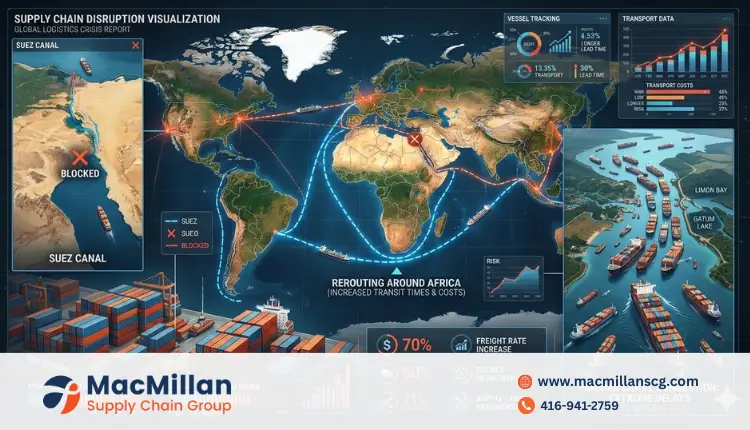
What You Need to Know About Supply Chain Disruption 2025 Global supply chains will face previously unheard-of difficulties due to supply chain disruption 2025. Ships have had to reroute around Africa due to the Red Sea crisis, which has increased shipping times by weeks and cost millions of dollars. Water shortages and maintenance problems are the main causes of the ongoing congestion in the Panama Canal. In the meantime, trade relations are changing as a result of post-election tariffs, especially between the US and China. Retail and the automotive industries are both feeling the effects of these disruptions. This playbook provides useful tactics for companies to overcome these obstacles, such as developing backup routing plans, deploying AI-driven forecasting, and nearshoring to Canada. Fast-adapting businesses will have a competitive edge in the face of supply chain disruption 2025. Introduction Why Supply Chain Resilience Matters in the Era of Supply Chain Disruption 2025 In 2025, a perfect storm is threatening the global supply chain. The Panama Canal congestion, the Red Sea shipping crisis, and new tariffs after recent elections have all combined to create previously unheard-of difficulties for businesses around the world. These are not merely short-term disruptions; rather, they signify significant changes in the global flow of goods. These disruptions present opportunities as well as challenges for Canadian companies. Everyone is impacted by increased costs and longer shipping times, but businesses that adjust swiftly can benefit greatly. The question is how you will handle these geopolitical challenges, not if they will have an impact on your supply chain. Each of these significant supply chain disruptions in 2025 will be covered in this playbook, along with an analysis of their effects on various industries and useful tactics to help your company not only survive but flourish. Maintaining competitiveness in today’s volatile global market requires an understanding of these changes, regardless of your industry—manufacturing, retail, or logistics. Red Sea Crisis and Its Role in Supply Chain Disruption 2025 In the context of supply chain disruption 2025, the Red Sea has changed from being an essential shipping route to a high-risk area. This vital maritime route has become more hazardous due to ongoing conflicts, which has forced shipping companies to make tough choices about how to transport goods between Asia and Europe. The Disruption Scale Nearly 80% of container ships have been forced to completely avoid the Suez Canal due to the Red Sea shipping crisis. Ships are instead choosing to take the longer route around the Cape of Good Hope in Africa, which adds 7–10 days to transit times and costs about $1 million more per voyage. An estimated 15% less shipping capacity has been available worldwide as a result of this rerouting, which has had an impact on supply chains. Emergency surcharges of $500 to $1,500 per container have been imposed by major carriers such as Maersk and ZIM. Raw materials to final goods are all impacted by these rising costs, which are unavoidably passed down the supply chain. Industry-Specific Impacts The automotive industry has been hit particularly hard by the Red Sea shipping crisis. Just-in-time manufacturing systems rely on predictable delivery schedules, and delays of even a few days can halt production lines. Similar issues arise for electronics manufacturers when parts from Asia take longer to arrive at assembly facilities in North America. This means that Canadian importers should budget for increased shipping expenses and longer lead times. Businesses that used to order inventory six weeks in advance now have to plan for eight to ten weeks, which causes smaller businesses to face more cash flow issues and ties up more capital in goods in transit. While the Red Sea situation dominates headlines, the Panama Canal is another major factor contributing to supply chain disruption 2025. Panama Canal Challenges: Water Shortages and Geopolitical Tensions In 2025, the Panama Canal will have its own set of issues, even as the Red Sea crisis makes headlines. The dependability of this vital trade route between the Atlantic and Pacific Oceans is in jeopardy due to political and natural issues. Environmental and Operational Restrictions The Panama Canal’s operations have been significantly impacted by climate change. Authorities have been forced to cut the number of daily transits from 36 to just 18 due to water shortages, causing a bottleneck that impacts shipping schedules worldwide. Ships now have to wait up to three weeks, as opposed to the usual three to five days in the past. With premium slots going to the highest bidders, the Panama Canal Authority has instituted a reservation system that ranks vessels according to cargo type and destination. For non-reserved vessels, this auction system has increased transit costs by 200–300%, putting further financial strain on shipping companies and their clients. Strategic Consequences For Canadian companies that depend on Asian imports reaching East Coast ports, the Panama Canal congestion is especially important. Although the volume of traffic using alternative routes through West Coast ports such as Vancouver and Prince Rupert has increased, the amount of traffic that can be diverted is limited by rail and truck capacity limitations. This disruption is accelerating the trend toward nearshoring, with many companies reconsidering their dependence on trans-Pacific supply chains. As businesses look for alternatives to Asian production, Mexican manufacturing has seen a 22% increase in capacity utilization. This change is also helping Canadian manufacturers, especially in industries like electronics assembly and automotive components where being close to US markets has major benefits. Election Tariffs: Navigating the New Trade Landscape With new tariffs reshaping supply chain economics in 2025, the US election of 2024 has brought about significant changes to the trade landscape. Businesses are being compelled by these policy changes to reevaluate their supply chain setups and sourcing tactics. The New Tariff Reality Under Trump’s 2025 tariffs, all imports will now be subject to 10% general duties, with targeted increases of up to 60% on Chinese goods. The cost equation for many products has been significantly changed by these actions, especially in the consumer goods, textile,
Cobots & Labor-Tech Solving Canada Warehouse Worker Shortage

The critical 11% vacancy rate in transportation and warehousing that Canada’s logistics industry faces is three times higher than the national average.Nationwide, the Canada warehouse worker shortage is causing supply chain disruptions and e-commerce fulfillment delays. A solution is provided by collaborative robots, or cobots, which can enhance human productivity by up to 30% while fostering safer working conditions. Businesses of all sizes can address labor shortages while increasing operational efficiency with flexible deployment strategies and government funding options like NRC IRAP, which cover up to 45% of implementation costs. This article examines how labor-tech and cobots are revolutionizing Canadian warehouses and opening up new doors for both companies and employees. Cobots & Labor-Tech: The Answer to Canada’s Warehouse Worker Shortage One major issue facing Canada’s warehouses is a severe labor shortage. Businesses find it difficult to satisfy customer demands, particularly in light of the e-commerce boom, as vacancy rates in transportation and warehousing reach 11%, which is three times the national average, this highlights the growing scale of the Canada warehouse worker shortage. This shortage affects the entire Canadian logistics industry and is not merely a short-term issue. However, there is hope for the future. Innovative labor-tech solutions and collaborative robots (cobots) are revolutionizing warehouses nationwide. Cobots are made to work alongside people, increasing productivity without completely replacing workers, in contrast to traditional industrial robots that operate alone. We’ll look at how these technologies are assisting Canadian companies in overcoming labor shortages, increasing productivity, and establishing safer workplaces in this post. We’ll also examine funding options, realistic implementation strategies, and the prospects for human-robot collaboration in Canada’s changing warehouse environment. Comprehending the Warehouse Labor Crisis in Canada With an 11% vacancy rate in the transportation and warehousing sectors, which is much higher than the 3.7% national average, Canada’s warehouse worker shortage has reached critical proportions. Not everyone is equally affected by this crisis; in Ontario alone, there are over 194,000 open positions, which causes supply chain bottlenecks that have an impact on both consumers and businesses. Ontario has been hit especially hard by the Canada warehouse worker shortage, making it the epicenter of warehousing strain in the country. This shortage is caused by multiple factors. First of all, working in a warehouse frequently entails physically taxing duties in uncomfortable settings, such as hot summers, cold winters, and a need for constant movement. Second, prospective employees are drawn away from logistics positions by rival industries that offer better compensation and working conditions, such as technology and healthcare. Third, fewer young people are pursuing these physically demanding jobs in Canada due to the country’s aging workforce. Businesses are significantly impacted. Delivery promises are especially difficult for e-commerce fulfillment centers, which have grown significantly since 2020. Businesses lose money and customers become dissatisfied when orders cannot be processed promptly. Smaller Canadian SMEs may experience an existential labor shortage as a result of their incapacity to offer competitive compensation or benefits. The Actual Price of Unfilled Jobs Missed deliveries are not the only financial impact. In order to make up for staff shortages, companies report spending an additional 30 to 45 percent on overtime. In the meantime, employee turnover in Canadian warehouses averages 36% per year, with training costs and lost productivity for each replacement coming to about $4,200. These figures demonstrate why, in the fiercely competitive Canadian logistics industry, finding technological solutions to the labor shortage is essential for survival as much as for growth. Ignoring the Canada warehouse worker shortage means risking both revenue and customer satisfaction. How Cobots Help Solve the Canada Warehouse Worker Shortage Compared to conventional industrial robots, collaborative robots, or cobots, represent a fundamentally different approach to warehouse automation. Cobots are made especially to work alongside human employees, enhancing rather than completely replacing their skills, whereas traditional robots operate in isolation behind safety cages. The inherent safety features of cobots are what set them apart. When a worker approaches too closely, they automatically slow down or stop using force-limited actuators and sophisticated sensors to detect human presence. This implies that there is no need for significant reconfiguration or safety precautions when deploying them directly in existing workspaces. These technologies offer real relief from the ongoing Canada warehouse worker shortage. Types of Cobots Transforming Canadian Warehouses Several facilities in Ontario use the DOBOT CR20A, which has AI vision systems that allow for real-time defect detection and dynamic worker movement adjustments. It can carry out tasks like palletizing and precise assembly with a payload capacity of 20 kg. Using LiDAR technology, autonomous mobile robots (AMRs) such as the OTTO 100 move objects up to 150 kg across warehouse floors without the need for fixed routes. AMRs are perfect for Canadian SMEs with limited funding because they don’t require costly floor modifications like traditional AGVs (Automated Guided Vehicles) do. For SMEs tackling the Canada warehouse worker shortage, AMRs provide flexible, cost-effective support that can be scaled without disruption. Cobots with modular grippers, like those from Geek+’s P Series, can be used for picking tasks and can be modified to handle anything from heavy car parts to delicate cosmetics. Because of its adaptability, a single robot can handle several jobs, increasing return on investment for Canadian companies on a tight budget. Implementation Strategies and ROI for Canadian Businesses It is not necessary to completely redesign the warehouse in order to implement cobots. Incremental deployment strategies, which minimize disruption while maximizing returns, are proving to be successful for many Canadian businesses. Before expanding, this strategy enables businesses to test technologies in particular domains. Workable Deployment Techniques The most economical place to start is frequently by retrofitting existing infrastructure. For instance, staging carts and OTTO 100 AMRs enable warehouses to automate transport tasks while preserving their existing layouts. Several distribution centers in the Toronto area have seen a 40% reduction in walking time without requiring significant renovations thanks to this technique. “Goods-to-person” systems can be introduced gradually for picking operations. Serving the Canadian market, Bergen Logistics began by implementing robotic picking stations
Electronics Supply Chain: Reshoring & 3PL in Canada
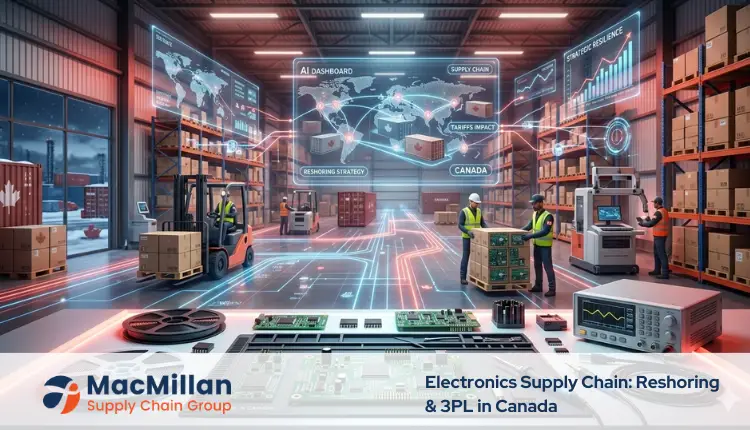
Growing tariffs, geopolitical unrest, and changing manufacturing environments present the electronics supply chain with previously unheard-of difficulties. This thorough guide examines the ways in which digital transformation, tariff mitigation, and strategic reshoring can help Canadian companies manage these challenges. These issues are closely connected to the broader US–China trade war and ongoing shifts in global supply chains. Specialized 3PL solutions are provided by MacMillan Supply Chain Group to assist businesses in strengthening their supply chains, cutting expenses, and increasing resilience. Learn useful strategies to prosper in the face of trade disruptions and set up your company for long-term success in Canada’s developing electronics industry, from utilizing foreign trade zones to putting blockchain traceability into place. This guide will help Canadian companies future-proof their electronics supply chain. The Changing Landscape of Electronics Manufacturing The electronics manufacturing industry is changing dramatically. Major economy-to-economy tariffs have risen to all-time highs, with some electronic components subject to 245% duties. Global supply chains have been rocked by this, and businesses are now being forced to reconsider where and how they manufacture their products. These issues offer opportunities as well as challenges to Canadian companies. Effectively managing tariffs has emerged as a crucial business ability, and reshoring in Canada presents a viable substitute for manufacturing that is done abroad. More flexibility, transparency, and resilience are now more important than ever in the electronic supply chain. Numerous Canadian electronics manufacturers have benefited from our assistance at MacMillan Supply Chain Group in adjusting to these shifting circumstances. In today’s intricate trading environment, our specialized 3PL services offer the infrastructure and know-how required to overcome supply chain interruptions and preserve competitive advantage. Understanding Tariff Impacts on Canadian Electronics For Canadian electronics companies, tariffs have become a major headache. Canadian companies are frequently caught in the crossfire of trade disputes between the United States and China. Before a Chinese-made component reaches its final destination in North America, it may be subject to several tariffs, which would significantly raise supply chain costs. Think about the effects of tariffs on semiconductors, which are the fundamental components of contemporary electronics. Everything from smartphones to medical devices is impacted when these tiny chips are subjected to 50% or more of the workload. Higher production costs, reduced margins, and challenging pricing decisions are what this means for Canadian manufacturers. Strategies for mitigating tariffs are now crucial business tools. Smart businesses are looking into possibilities such as: Strategic inventory control (purchasing prior to the imposition of tariffs) Replacement of components with non-tariffed substitutes Moving assembly to areas that comply with the USMCA Utilizing the benefits of foreign trade zones to postpone duty payments Through specialized logistics planning, MacMillan assists Canadian companies in putting these strategies into practice. Our customs compliance specialists examine tariff codes, spot areas for improvement, and create customized solutions that reduce duty exposure while preserving supply chain effectiveness. Reshoring: Relocating Electronics Production to Canada As companies reevaluate their global manufacturing strategies, the idea of reshoring in Canada has gained a lot of traction. While tariffs reduced the economic appeal of offshore production, the pandemic revealed weaknesses in extended supply chains. Many electronics manufacturers are moving their manufacturing closer to home these days. This change has been largely attributed to Canadian manufacturing incentives. Companies that invest in domestic production can receive grants, tax breaks, and other forms of assistance from federal and provincial programs. By creating more robust supply networks, these incentives aid in offsetting the higher labor costs connected to North American manufacturing. Reshoring has advantages beyond just the bottom line: Shorter lead times and lower transportation expenses Improved quality assurance and protection of intellectual property Easier adherence to North American trade laws Reduced shipping distances result in a smaller carbon footprint Increased responsiveness and visibility in the supply chain At MacMillan, we provide specialized warehousing, distribution, and logistics services to support reshoring initiatives. Our well-positioned facilities across Canada give businesses the framework they need to successfully execute reshoring plans, and our cross-border knowledge guarantees seamless integration with American markets. Digital Transformation in the Canadian Electronics Supply Chain Canadian businesses in the electronics supply chain are turning to digital platforms the way electronic supply chains function is being revolutionized by technology. Businesses can now confidently navigate complex trade environments thanks to AI-driven supply chain solutions, which offer previously unheard-of visibility and control. Among the most potent uses of this technology are BOM optimization tools. Before production starts, these systems find cost-saving options by comparing bills of materials to tariff databases. Manufacturers can incorporate tariff mitigation into their product designs from the outset by choosing components according to origin, classification, and duty exposure. Another significant benefit is blockchain traceability. Immutable records of a component’s movement through the supply chain are produced by this technology, offering: Verifiable proof of origin for customs declarations Defense against the supply of fake parts Automated documentation for regulatory compliance Visibility in real time over intricate multi-tier networks MacMillan helps customers use technology to gain a competitive edge by incorporating these digital capabilities into our logistics services. Our systems offer real-time data flows that facilitate improved decision-making across the supply chain by integrating seamlessly with manufacturer ERPs. Regional Alternatives and Trade Agreements Pure domestic production isn’t always possible, even though reshoring has many advantages. For this reason, a lot of Canadian electronics companies are looking into regional options that strike a balance between supply chain resilience and cost considerations. Opportunities for nearshoring to Mexico have garnered a lot of interest. Mexico provides competitive labor rates and duty-free access to the U.S. and Canadian markets as a member of the USMCA trade zone. Mexico is now the production center for many electronics manufacturers’ “China+1” strategies in the Western Hemisphere. Important frameworks for cross-border trade are provided by the USMCA agreement itself. Electronics manufacturers can avoid tariffs and preserve effective production networks by adhering to regional content requirements. For competitive positioning, it is essential to comprehend and take advantage of these provisions. Southeast Asian countries for large-scale manufacturing, such as Vietnam and
Trump’s 50% Steel Tariffs: Supply Chain Disruption Explained

Former U.S. President Donald Trump announced Trump’s 50% steel tariffs, doubling the previous 25% rate — a move that has rocked North American supply chains. Numerous industries are deeply concerned about this sharp rise, which is justified by Section 232 measures as necessary for national security. There are currently significant obstacles facing Canada’s steel industry, which exports steel products worth billions of dollars to the United States each year. These tariffs cause a complicated web of supply chain issues for companies that operate across the Canada-U.S. border. Consumer prices could rise and economic growth could be slowed by higher material costs, possible shortages, and logistical issues. Strategic supply chain management is more important than ever as Canadian manufacturers and their American consumers scramble to adapt. Understanding Trump’s 50% Steel Tariffs Trade tensions between the US and its trading partners, including Canada, have significantly increased as a result of Trump’s 50% steel tariffs. The Trade Expansion Act’s Section 232 measures, which give the US the authority to defend domestic industries considered essential to national security, are the basis for these tariffs. International partners and trade experts have criticized the national security rationale. Many contend that this line of thinking expands the meaning of security concerns to encompass economic protectionism. By raising the price of imported steel considerably, the policy seeks to support domestic steel producers in the United States. These tariffs present immediate difficulties for Canadian companies: Higher border crossing costs for steel-based materials Possible supply disruptions as trade patterns change Price and availability uncertainty for manufacturing inputs Difficult customs procedures and extra paperwork Businesses have limited time to modify their supply chains or look for alternate sourcing options due to the implementation timeline. The economy as a whole is impacted by this abrupt change, which forces businesses to either absorb increased costs or pass them on to customers. How Canadian Steel Industry and Manufacturers Are Affected The steel sector in Canada is at the forefront of this trade conflict. Canadian steel producers, a significant supplier to American markets, could suffer catastrophic repercussions. According to industry analysts, if these tariffs are maintained over time, domestic steel producers may lose billions of dollars in revenue. A double challenge confronts Canadian manufacturers who depend on steel inputs, in addition to the steel producers themselves. As Canadian producers adjust to lost U.S. market share, domestic steel buyers may see price increases. In the meantime, possible retaliatory tariffs increase the costs for manufacturers who import specialty steel from the United States. Among the issues facing the manufacturing sector are: Reduced ability to compete with international competitors Pressure to move production to avoid tariffs Difficulty keeping customer prices stable Difficulties with long-term planning and investment Because they frequently lack the resources to swiftly change their supply chains or absorb large cost increases, small and medium-sized manufacturers face especially difficult obstacles. Some businesses are already delaying plans for expansion and reevaluating their cross-border business strategies, according to industry associations. How Trump’s 50% Steel Tariffs Are Driving Up Construction and Auto Costs Trump’s 50% steel tariffs are putting immediate pressure on the construction sector. Steel accounts for a sizeable portion of material costs in both residential and commercial construction projects. According to industry experts, steel-intensive projects may see construction costs rise by 15% to 20%, making Canada’s housing affordability crisis worse. For Canada’s construction industry, which is already struck by high material costs and a lack of workers, the timing couldn’t be worse. Builders report: Delays in projects while budgets and material sourcing are reevaluated Contracts should be renegotiated to take price volatility into account Accurate quotes for upcoming projects are difficult to come by Project viability is a concern as costs increase In a similar vein, the automotive industry has particular difficulties. Vehicle manufacturing depends on components that cross borders several times due to integrated supply chains that span both nations. This carefully calibrated system could be upset by the tariffs, which could result in: Consumers paying more for cars Assembly plant production slowdowns Job losses in auto manufacturing regions A quicker transition to sourcing from overseas markets Tinplate Packaging and Consumer Goods Price Increases Tinplate packaging is one frequently disregarded area that is experiencing major disruption. This specialty steel product is necessary for many consumer goods, including beverage containers and food canning. Packaging manufacturers must deal with significant cost increases as a result of the tariffs, which will eventually affect consumers. Within months of going into effect, the 50% tariff could raise the cost of canned food by 8–12%, according to the Can Manufacturers Institute. Lower-income households that depend on reasonably priced canned goods would be disproportionately affected by this price inflation. In addition to food, consumers can anticipate price increases in a variety of categories: Steel-based appliances and household items Costs of auto parts and repairs Building supplies and home remodeling items Office supplies and furnishings At a time when many households are already experiencing financial strain, these price increases add to concerns about consumer price inflation in general. Economists caution that the tariffs might act as a regressive tax, burdening the most vulnerable. Challenges Facing Businesses Under the New Tariff Regime Businesses on both sides of the border face many operational difficulties as a result of Trump’s 50% steel tariffs. These issues go beyond straightforward price hikes to include serious supply chain interruptions. Planning becomes nearly impossible due to the uncertainty surrounding the policy’s implementation. Companies struggle to decide whether to pass costs on to customers, seek alternative suppliers, or lock in current prices — all while facing delayed investment decisions and a wait-and-see mentality. Beyond steel, the global supply chain faces ripple effects as manufacturers shift their sourcing strategies, causing potential shortages of other materials and components. Legal complications further muddy the waters. With disputes progressing through the WTO and domestic courts, businesses must prepare for outcomes ranging from tariff reductions to retaliatory measures. Fourth, simple substitution isn’t always feasible due to the specialized nature of many steel products. Regardless of cost,