A Quick Summary and Overview
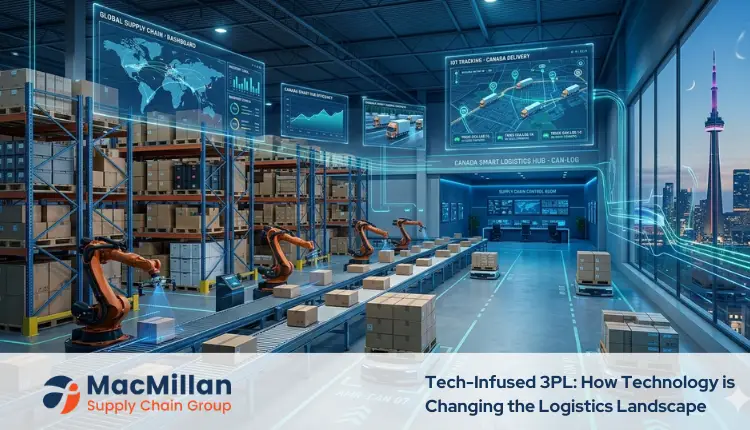
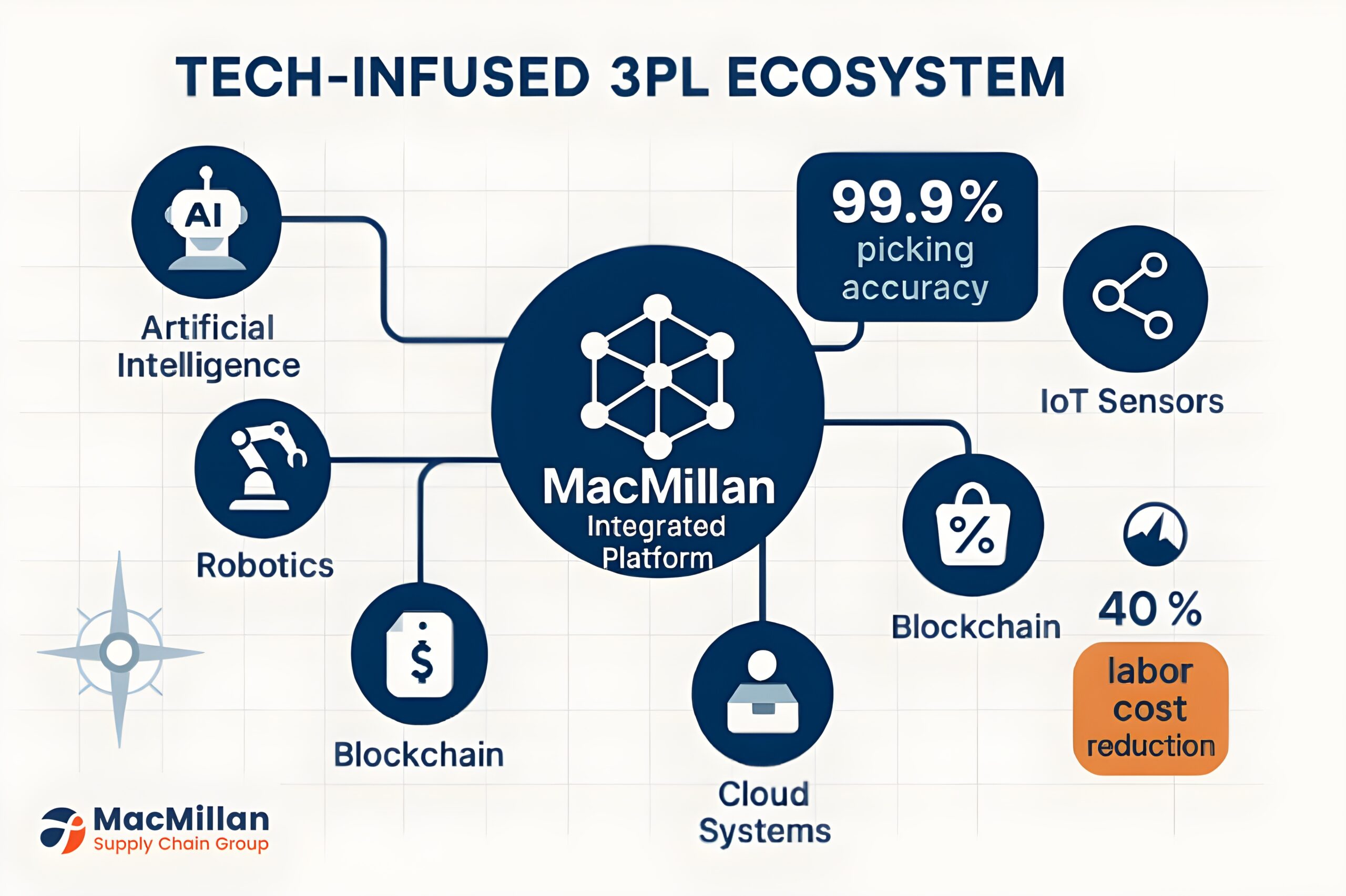
The logistics industry is experiencing a technological revolution that’s reshaping how goods move from manufacturers to consumers. Tech-infused 3PL combines artificial intelligence, robotics, IoT sensors, and advanced analytics to create smarter, faster, and more reliable supply chains. At MacMillan Supply Chain Group, we’re leading this transformation in the Canadian market, helping businesses optimize operations, reduce costs, and improve customer satisfaction through innovative logistics technology. This article explores how these technologies are changing the logistics landscape and why partnering with a tech-forward 3PL provider is essential for modern business success.
Introduction
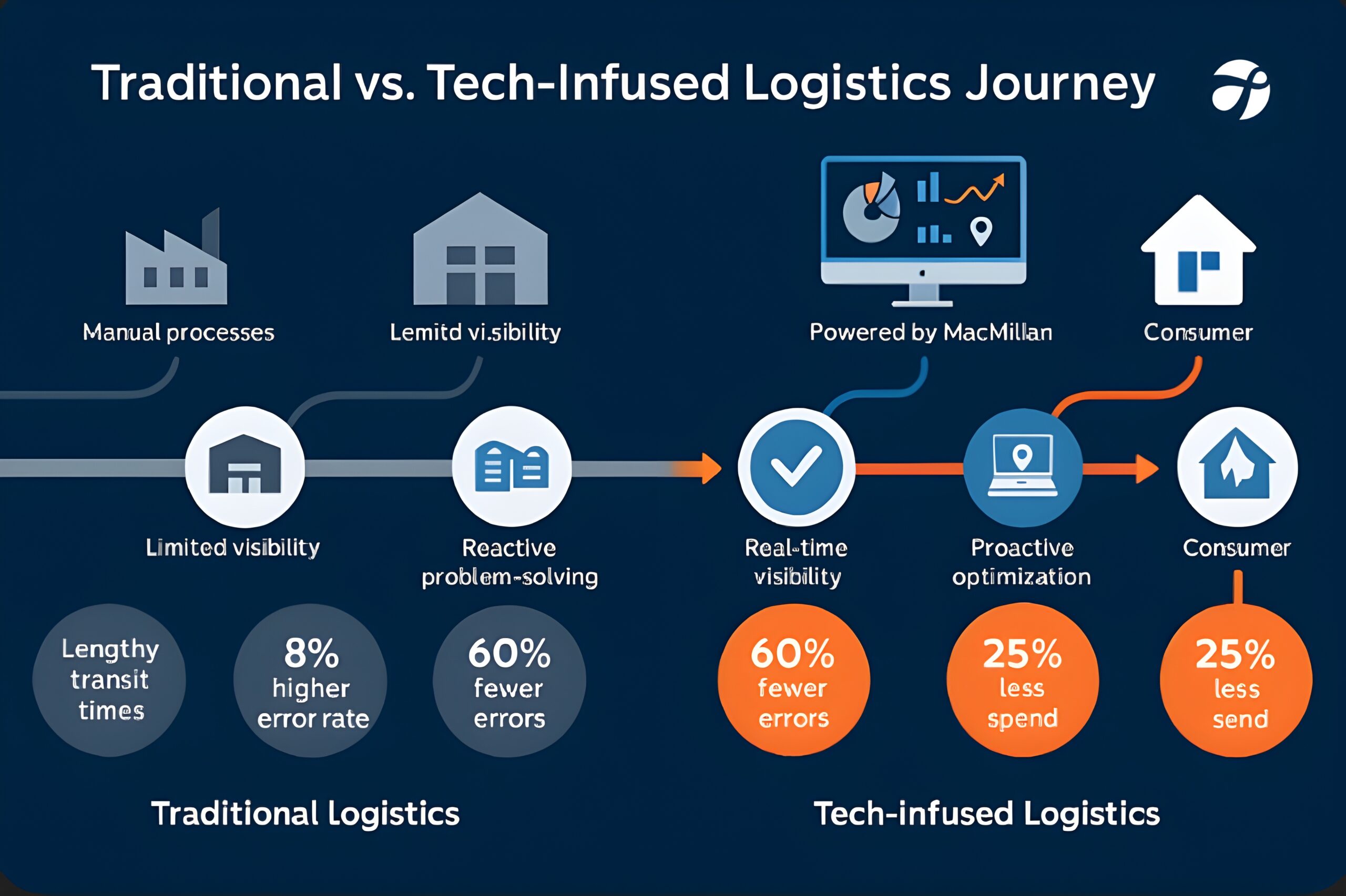
The logistics industry has come a long way from manual processes and paper trails. Today, technology is fundamentally transforming how third-party logistics (3PL) providers operate, creating unprecedented efficiency and visibility throughout the supply chain. This tech-infused approach is revolutionizing everything from warehouse operations to last-mile delivery.
In the Canadian 3PL market, where businesses face unique challenges of vast geography and variable weather conditions, technology adoption isn’t just an advantage—it’s a necessity. Digital transformation in logistics is enabling companies to overcome these challenges while meeting rising customer expectations for speed and transparency.
At MacMillan Supply Chain Group, we’ve embraced this technological revolution, implementing cutting-edge solutions that streamline operations and provide superior service. But what exactly makes a 3PL provider “tech-infused,” and how are these technologies changing the logistics landscape? Let’s explore the innovations reshaping our industry and how they benefit businesses across Canada.
AI and Machine Learning: The Brain of Modern Logistics
Artificial intelligence and machine learning represent the cognitive center of tech-infused 3PL operations. These technologies analyze massive datasets to identify patterns, make predictions, and optimize decisions in ways that human operators simply cannot match.
AI in supply chain management transforms raw data into actionable insights, enabling smarter inventory management and demand forecasting. For example, AI algorithms can analyze historical sales data alongside external factors like weather patterns, local events, and economic indicators to predict future demand with remarkable accuracy. This helps businesses maintain optimal inventory levels—not too much (which ties up capital) and not too little (which leads to stockouts).
Route optimization is another area where AI shines. Traditional route planning might consider basic factors like distance, but AI systems evaluate countless variables simultaneously: traffic patterns, weather conditions, delivery time windows, vehicle capacities, driver schedules, and even customer preferences. The result? Faster deliveries, lower fuel costs, and improved customer satisfaction.
At MacMillan Supply Chain Group, our AI-powered systems continuously learn from each delivery, becoming increasingly efficient over time. This machine learning capability means our logistics solutions aren’t static—they evolve and improve automatically, adapting to changing conditions and incorporating new data to deliver ever-better results for our clients.
Robotics and Automation: Transforming Warehouse Operations
Robotics in warehousing has revolutionized how products are stored, picked, and packed. These technologies are no longer futuristic concepts—they’re operational realities delivering measurable benefits in modern fulfillment centers.
Automated guided vehicles (AGVs) navigate warehouse floors independently, transporting goods between stations without human intervention. These tireless workers operate 24/7, dramatically increasing throughput while reducing labor costs and human error. Meanwhile, robotic picking systems can identify, grasp, and move individual items with precision that rivals or exceeds human capabilities.
Warehouse automation solutions extend beyond robots to include sophisticated conveyor systems, automated storage and retrieval systems (AS/RS), and goods-to-person technologies that bring products directly to packing stations. These integrated systems work in harmony to process orders with unprecedented speed and accuracy.
The benefits of automation are particularly evident in e-commerce logistics, where high order volumes and expectations for rapid fulfillment create intense operational pressure. Our automated facilities at MacMillan can process thousands of orders daily with 99.9% accuracy, enabling next-day and same-day delivery options that would be impossible with traditional manual processes.
IoT and Real-Time Visibility: The Connected Supply Chain
The Internet of Things (IoT) has created unprecedented visibility throughout the supply chain by connecting physical objects to digital networks. This connectivity transforms static supply chains into dynamic, responsive systems that can be monitored and optimized in real time.
IoT fleet management uses connected sensors on vehicles to track location, monitor fuel consumption, assess driver behavior, and evaluate vehicle health. These systems enable proactive maintenance that prevents breakdowns, optimizes fuel efficiency, and ensures regulatory compliance. For temperature-sensitive goods like pharmaceuticals or food products, IoT sensors continuously monitor conditions, triggering alerts if temperatures drift outside acceptable ranges.
Real-time tracking solutions extend beyond vehicles to the products themselves. RFID tags, GPS trackers, and other connected devices provide item-level visibility throughout the journey from manufacturer to consumer. This granular tracking enables precise delivery estimates and proactive problem-solving when issues arise.
At MacMillan Supply Chain Group, our connected logistics network generates a continuous stream of data that feeds our analytics platforms. This real-time information allows us to make dynamic adjustments to routes, reallocate resources, and keep customers informed about their shipments’ status. The result is a more agile, responsive, and transparent supply chain that delivers superior results for our clients.
Blockchain and Data Security: Building Trust in the Supply Chain
Blockchain technology is bringing unprecedented transparency and security to logistics operations. This distributed ledger system creates immutable records of transactions and events, providing a single source of truth that all supply chain participants can trust.
In shipping and logistics, blockchain creates transparent, tamper-proof records of a product’s journey from origin to destination. This capability is particularly valuable for high-value goods, pharmaceuticals, and food products where authenticity and handling conditions are critical concerns. When implemented properly, blockchain in shipping can virtually eliminate counterfeiting and provide indisputable evidence of proper handling throughout the supply chain.
Beyond product tracking, blockchain streamlines documentation processes that have traditionally been paper-heavy and time-consuming. Smart contracts—self-executing agreements with terms written directly into code—can automatically trigger payments when predefined conditions are met, such as successful delivery confirmation.
Data security is another crucial aspect of tech-infused 3PL operations. As supply chains become increasingly digital, protecting sensitive information from cyber threats becomes paramount. At MacMillan Supply Chain Group, we implement robust cybersecurity measures to safeguard our systems and our clients’ data, ensuring that the benefits of digital transformation don’t come at the cost of increased vulnerability.
Common Problems with Traditional Logistics Approaches

Despite technological advances, many businesses still struggle with outdated logistics processes that create significant challenges:
- Limited visibility: Traditional supply chains often operate with minimal transparency, making it difficult to track shipments, anticipate delays, or identify inefficiencies.
- Reactive problem-solving: Without real-time data, issues are typically addressed only after they’ve already caused disruptions, leading to delays and customer dissatisfaction.
- Manual processes: Paper-based systems and manual data entry are slow, error-prone, and resource-intensive, creating bottlenecks throughout the supply chain.
- Inefficient resource allocation: Without advanced analytics, companies struggle to optimize inventory levels, vehicle routing, and warehouse operations, leading to wasted resources and higher costs.
- Poor scalability: Traditional logistics operations often struggle to handle volume fluctuations, particularly during peak seasons or periods of rapid growth.
- Siloed information: When data is trapped in departmental silos, it prevents the holistic view needed for truly optimized supply chain management.
- Slow adaptation: Without the agility provided by technology, traditional logistics operations struggle to adapt to changing market conditions, customer expectations, or disruptions.
Our Solutions: Tech-Infused 3PL Excellence

At MacMillan Supply Chain Group, we’ve developed comprehensive solutions to address these challenges through our tech-infused 3PL approach:
Integrated Technology Platform
Our cloud-based logistics management system serves as the central nervous system of our operations, connecting all aspects of the supply chain. This integrated platform eliminates silos by bringing together warehouse management, transportation management, order processing, and analytics in a single, unified system. Clients gain access to customizable dashboards that provide real-time visibility into their operations, enabling data-driven decisions and proactive management.
The platform’s open architecture facilitates seamless integration with client systems through standardized APIs, eliminating double data entry and ensuring information flows smoothly between systems. This integration capability extends to e-commerce platforms, ERP systems, and marketplace channels, creating a truly connected ecosystem.
AI-Powered Optimization

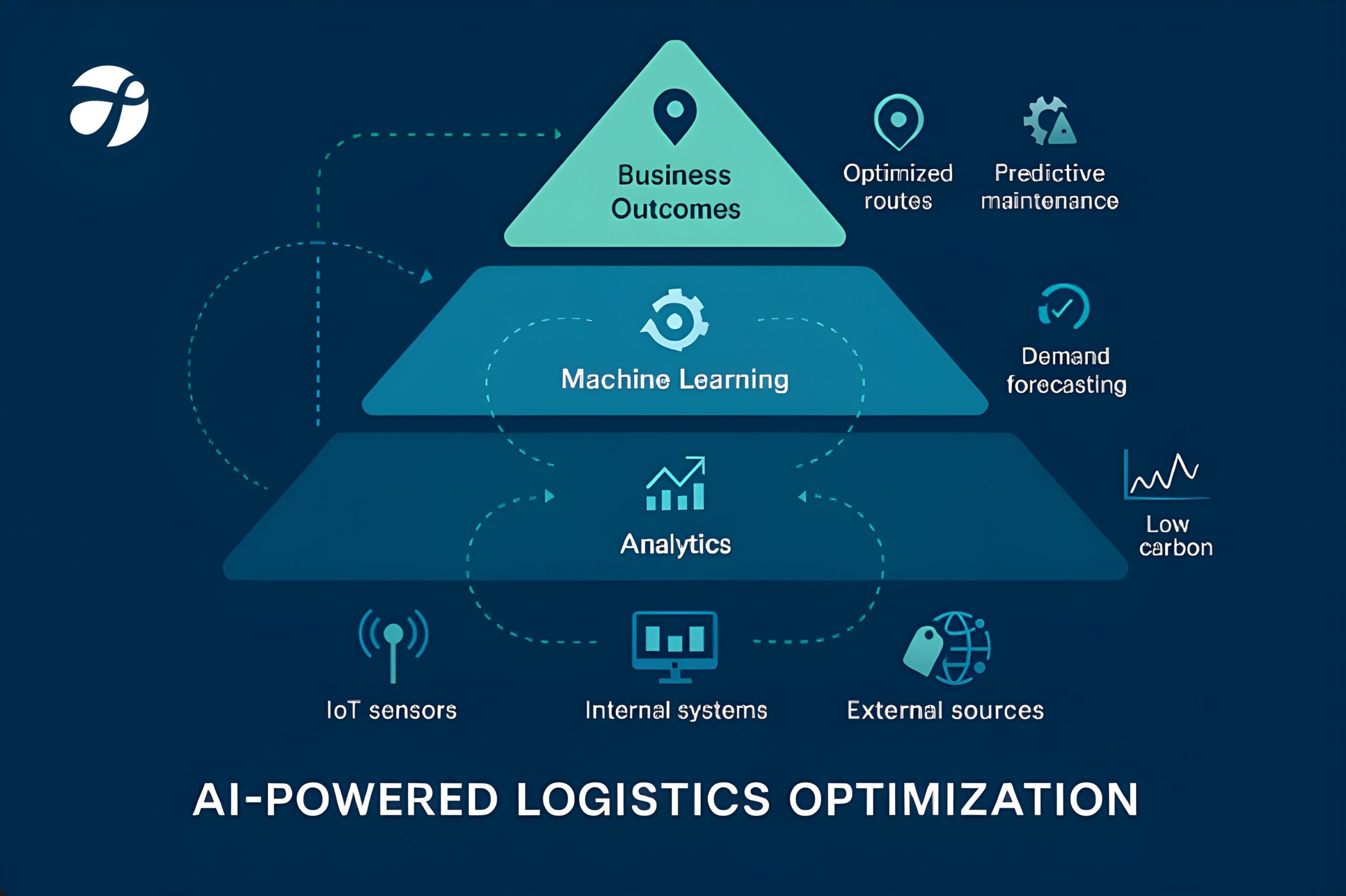
Our artificial intelligence systems continuously analyze operational data to identify patterns, predict outcomes, and recommend improvements. These capabilities transform every aspect of logistics management:
Demand forecasting: Our predictive models analyze historical data alongside market trends, seasonal factors, and promotional activities to forecast demand with remarkable accuracy, helping clients maintain optimal inventory levels.
Intelligent routing: AI algorithms consider multiple variables simultaneously—traffic patterns, weather conditions, delivery windows, vehicle capacities—to create optimized delivery routes that minimize costs while meeting service commitments.
Exception management: The system automatically identifies potential disruptions and suggests mitigation strategies before problems impact customers, turning potential crises into manageable situations.
Advanced Warehouse Automation
Our fulfillment centers leverage cutting-edge automation technologies to maximize efficiency and accuracy:
- Robotic picking and packing: Automated systems handle routine tasks with speed and precision that exceed human capabilities, reducing labor costs while improving accuracy.
- Goods-to-person systems**: Rather than having workers walk miles each day searching for products, our automated systems bring items directly to packing stations, dramatically increasing productivity.
- Intelligent storage optimization: AI algorithms continuously analyze product characteristics, order patterns, and seasonality to optimize warehouse layouts, placing fast-moving items in easily accessible locations.
Connected Fleet Management
Our transportation operations leverage IoT technology to create a responsive, efficient delivery network:
- Real-time tracking: GPS-enabled vehicles provide continuous location updates, enabling accurate delivery estimates and proactive rerouting when necessary.
- Predictive maintenance: Onboard diagnostics monitor vehicle health in real-time, identifying potential issues before they cause breakdowns and scheduling maintenance during non-peak periods.
- Driver performance optimization: Telematics systems analyze driving patterns to identify opportunities for improved safety and fuel efficiency, providing drivers with actionable feedback.
Blockchain-Enabled Transparency
Our implementation of blockchain technology creates unprecedented supply chain transparency:
- Immutable audit trails: Every touchpoint in the supply chain is recorded on a distributed ledger, creating indisputable evidence of handling procedures and chain of custody.
- Automated compliance: Smart contracts automatically verify that regulatory requirements have been met at each stage, reducing administrative burden while ensuring compliance.
- Simplified documentation: Digital records replace traditional paperwork, streamlining customs clearance and reducing the risk of delays due to documentation errors.
How to Implement Tech-Infused Logistics Solutions
Transitioning to a tech-infused logistics approach doesn’t have to be overwhelming. Here’s how businesses can successfully implement these solutions:
- Start with a thorough assessment: Evaluate your current logistics operations to identify pain points, inefficiencies, and opportunities for improvement. This baseline understanding will help you prioritize technology investments for maximum impact.
- Develop a phased implementation plan: Rather than attempting a complete overhaul overnight, create a staged approach that introduces new technologies incrementally. This reduces risk and allows your team to adapt gradually.
- Choose the right technology partners: Look for providers with proven expertise in logistics technology and a track record of successful implementations. The right partner will understand your specific challenges and tailor solutions accordingly.
- Invest in training and change management: Technology is only effective when people use it properly. Comprehensive training programs and thoughtful change management strategies are essential for successful adoption.
- Measure results and iterate: Establish clear metrics to evaluate the impact of your technology investments, and be prepared to make adjustments based on real-world performance.
For businesses looking to accelerate their logistics transformation, partnering with MacMillan Supply Chain Group offers a faster path to results. Our team brings decades of logistics expertise combined with cutting-edge technology capabilities, allowing you to leverage our investments and experience rather than building everything from scratch.
Contact MacMillan Supply Chain Group today to discover how our tech-infused 3PL solutions can transform your logistics operations. Our consultative approach begins with understanding your unique challenges and objectives, then designing a customized solution that delivers measurable improvements in efficiency, visibility, and customer satisfaction. Whether you’re looking to optimize a specific aspect of your supply chain or implement a comprehensive logistics transformation, we have the expertise and technology to help you succeed.