
Advancements in Last-Mile Delivery Transforming Canada
The Evolution of Last-Mile Delivery in Canada The e-commerce industry…


The Evolution of Last-Mile Delivery in Canada The e-commerce industry…

What You Need to Know About Supply Chain Disruption 2025…

The critical 11% vacancy rate in transportation and warehousing that…

Growing tariffs, geopolitical unrest, and changing manufacturing environments present the…
In today’s fast-paced business environment, meeting customer expectations isn’t just important—it’s essential for survival. When you partner with a third-party logistics (3PL) provider like MacMillan Supply Chain Group, one of the most powerful tools at your disposal is buffer inventory.
But what exactly is buffer inventory? Simply put, it’s additional stock kept on hand beyond what’s needed for immediate demand. Think of it as your safety net—ready to deploy when unexpected situations arise. In 3PL operations, this extra inventory helps maintain service levels despite supply chain disruptions, demand spikes, or delivery delays.
For Canadian businesses navigating complex supply chains, buffer inventory isn’t just a nice-to-have—it’s a strategic necessity. Whether you’re shipping across the Greater Toronto Area or managing cross-border fulfillment between Canada and the US, proper safety stock management ensures your customers get what they need, when they need it. Let’s explore how this works and why it matters to your business.
Buffer inventory plays a crucial role in modern third-party logistics, transforming how businesses approach fulfillment and customer satisfaction. But how exactly does it work within a 3PL environment?
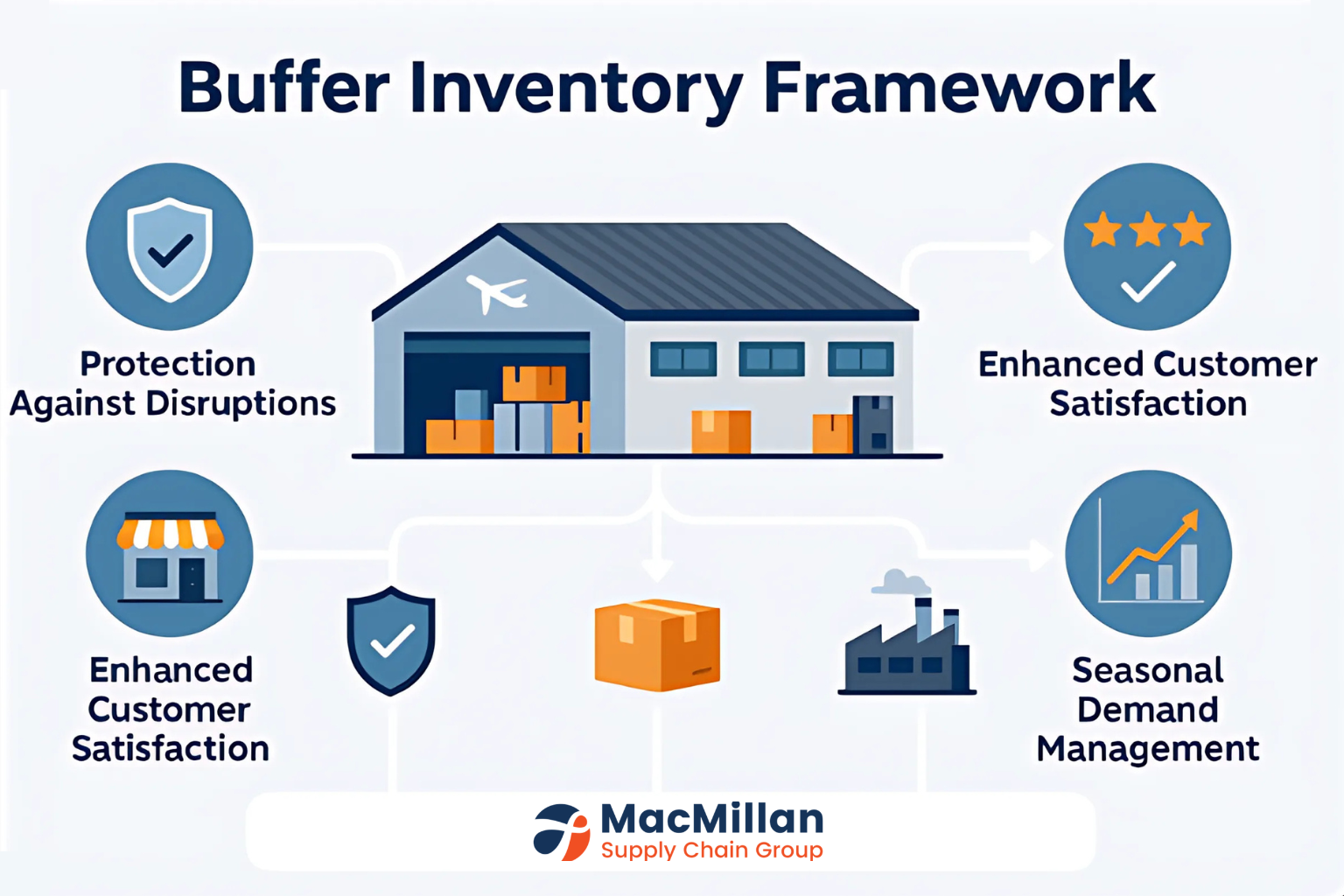
In traditional inventory management, companies often struggle with the balance between having too much stock (increasing carrying costs) and too little (risking stockouts). This is where 3PL providers like MacMillan Supply Chain Group add tremendous value. We maintain strategically positioned buffer inventory across our fulfillment network, creating multiple benefits:
Supply chains face constant challenges—from weather events affecting transportation to supplier delays or global disruptions. Buffer inventory provides a cushion against these uncertainties. When a shipment from your manufacturer is delayed, your safety stock ensures orders still go out on time.
Today’s consumers expect fast, reliable delivery. With buffer inventory strategically positioned in our Canadian fulfillment centers, we can offer same-day or next-day shipping to major markets. This speed creates competitive advantage and builds customer loyalty.
Most businesses experience fluctuating demand throughout the year. During peak seasons like holidays or promotional periods, buffer inventory prevents stockouts when orders surge. Our warehouse management system (WMS) tracks these patterns and adjusts safety stock levels accordingly.
By integrating buffer inventory into your 3PL strategy, you’re not just storing extra products—you’re creating a responsive supply chain that can adapt to changing market conditions while maintaining consistent service levels.
Determining the right amount of buffer inventory isn’t guesswork—it’s a science that combines data analysis with strategic planning. At MacMillan Supply Chain Group, we use sophisticated approaches to calculate optimal safety stock levels for each product in your inventory.
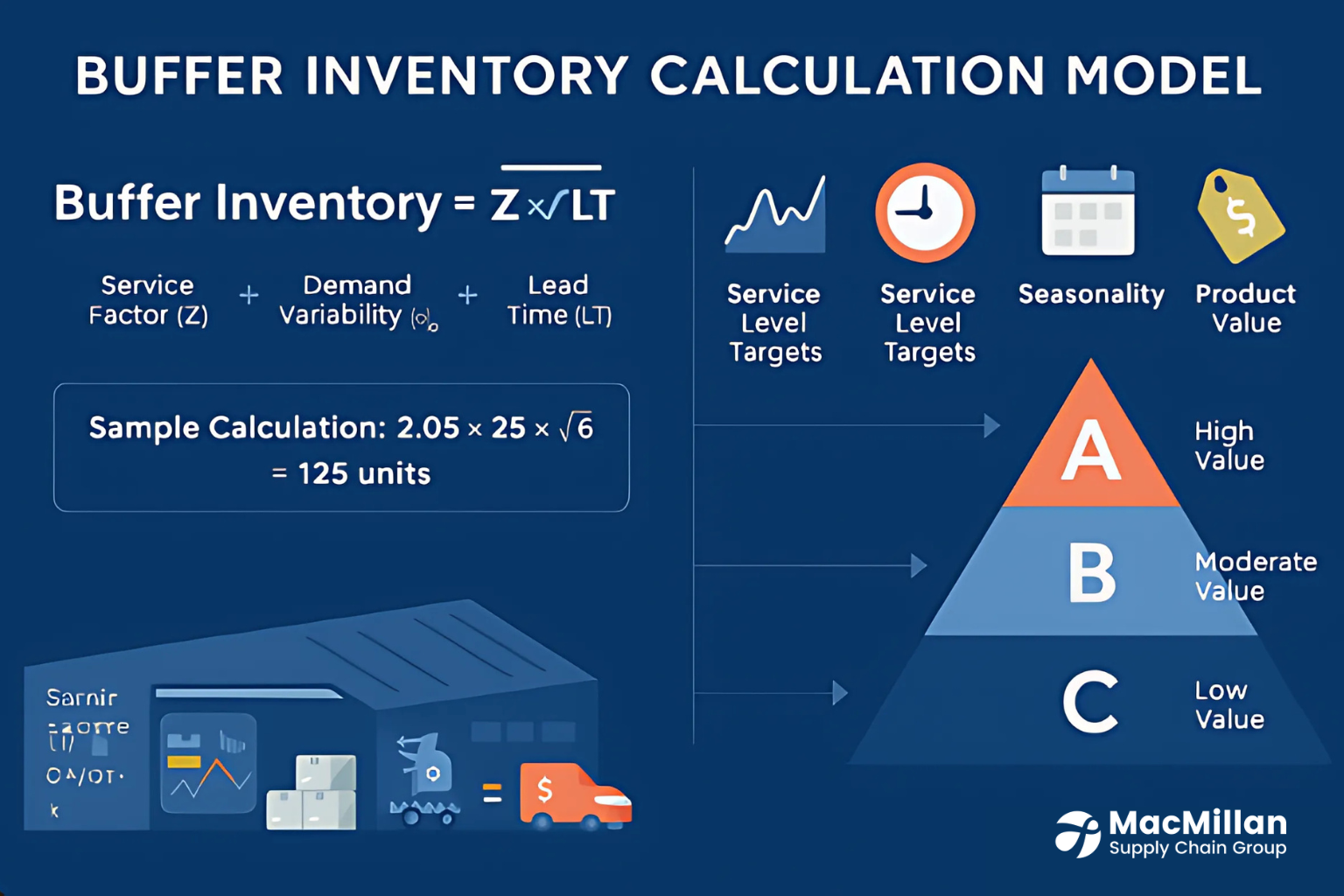
Several variables influence how much buffer stock you should maintain:
Our inventory optimization experts use these factors in mathematical formulas to determine precise safety stock requirements. For example, a basic calculation might look like:
Safety Stock = Z-score × Standard Deviation of Demand × √Lead Time
Where the Z-score represents your desired service level (higher Z-scores provide greater protection against stockouts).
Not all products deserve the same buffer strategy. We implement ABC analysis in inventory management to categorize your products:
This segmentation ensures you’re investing in buffer inventory where it matters most, optimizing both service levels and carrying costs across your product range.
The effectiveness of buffer inventory depends heavily on the technology systems supporting it. Modern 3PL providers like MacMillan Supply Chain Group leverage advanced warehouse management systems (WMS) and integrated technologies to optimize safety stock management.
Our WMS provides complete visibility into your inventory levels across all locations. This transparency allows for:
With real-time visibility, both our team and yours can make informed decisions about inventory positioning and replenishment.
Beyond tracking current inventory, our systems use predictive analytics to anticipate future needs. By analyzing historical sales data, seasonal patterns, and market trends, we can forecast demand with remarkable accuracy. This demand forecasting capability allows us to:
The combination of real-time visibility and predictive analytics creates a dynamic buffer inventory system that continuously adapts to changing conditions. Rather than static safety stock levels that might be reviewed quarterly, our technology enables weekly or even daily adjustments to optimize your inventory investment while maintaining service levels.
Where you position your buffer inventory is just as important as how much you maintain. MacMillan Supply Chain Group’s extensive fulfillment network across Canada allows for strategic geographic distribution of safety stock to maximize efficiency and service levels.
Distributing buffer inventory across multiple fulfillment centers offers several key benefits:
For example, a Toronto-based retailer might maintain primary inventory in Ontario while positioning buffer stock in Vancouver to serve western Canadian customers with next-day delivery. This approach reduces both shipping costs and delivery times compared to fulfilling all orders from a single location.
One of the most challenging supply chain phenomena is the “bullwhip effect”—where small changes in consumer demand create increasingly larger fluctuations in inventory requirements upstream. Buffer inventory strategically positioned throughout the supply chain helps dampen these oscillations.
Our distribution centre operations are designed to absorb these demand variations through carefully calculated safety stock at each node in the network. This geographic buffer strategy creates a more stable supply chain that can respond to market changes without the extreme inventory swings that often plague less sophisticated operations.
While buffer inventory offers significant benefits, it also presents several challenges that businesses must navigate carefully. Understanding these potential pitfalls is essential for developing effective safety stock strategies.
Perhaps the most obvious challenge is the financial impact of maintaining buffer stock. Every item in your safety inventory represents tied-up capital that could be used elsewhere in your business. Additional costs include:
Forecasting Limitations
Even the most sophisticated demand forecasting systems have limitations. Unexpected market shifts, new competitors, or sudden changes in consumer preferences can render historical data less relevant. When forecasts are inaccurate, buffer inventory levels may be too high or too low.
Finding the optimal balance between customer service and inventory costs remains a persistent challenge. Higher service levels require more buffer inventory, increasing carrying costs. Lower buffer levels reduce costs but may lead to stockouts and disappointed customers.
Coordination Across Supply Chain Partners
Effective buffer management requires coordination between manufacturers, distributors, 3PL providers, and retailers. Poor communication or misaligned incentives can lead to duplicate safety stock or gaps in coverage.
Different products present unique buffer inventory challenges:
These common problems highlight why professional 3PL management of buffer inventory is so valuable—experienced providers have developed strategies to address these challenges while maximizing the benefits of safety stock.
At MacMillan Supply Chain Group, we’ve developed comprehensive solutions to the challenges of buffer inventory management. Our approach combines industry expertise, advanced technology, and strategic thinking to create buffer inventory systems that maximize benefits while minimizing costs.
Rather than setting static safety stock levels, we implement dynamic buffer management that continuously adjusts to changing conditions. This approach includes:
For example, when working with a Canadian fashion retailer, we increased buffer inventory before their seasonal promotions but reduced it for steady-selling basics, resulting in 22% lower overall inventory costs while maintaining 99.7% order fill rates.
Our risk mitigation in logistics approach addresses supply chain uncertainties through:
During recent supply chain disruptions, clients utilizing our distributed buffer approach maintained 98% service levels while competitors experienced significant stockouts.
Our warehouse management system (WMS) provides powerful tools for buffer inventory optimization:
This technology foundation enables precise control over buffer inventory, ensuring you maintain just enough safety stock to meet service goals without excess.

For businesses serving both Canadian and US markets, we implement specialized cross-border shipping strategies:
These cross-border approaches have reduced delivery times by an average of 1.7 days while maintaining appropriate buffer levels on both sides of the border.
We recognize that different industries have unique buffer requirements:
By tailoring our buffer inventory strategies to your specific industry needs, we create solutions that address your unique challenges while leveraging industry best practices.
Through these comprehensive approaches, MacMillan Supply Chain Group transforms buffer inventory from a necessary cost into a strategic advantage that enhances your customer service while optimizing your overall supply chain performance.
Ready to transform your approach to buffer inventory? Here’s how you can partner with MacMillan Supply Chain Group to implement an effective safety stock strategy that enhances your supply chain performance.
The journey begins with a thorough analysis of your current inventory situation. Our experts will:
This assessment provides the foundation for a customized buffer inventory strategy tailored to your business needs.