
7 Signs Your Brand Has Outgrown Its Current 3PL
A Quick Summary and Overview Many brands do not realize…

A Quick Summary and Overview Many brands do not realize…

Scale Your Operations Without Scaling Your Payroll Expanding your team…
Canada Post Workers Strike: What It Means for Your Business…

A Quick Summary and Overview For beauty and wellness brands,…
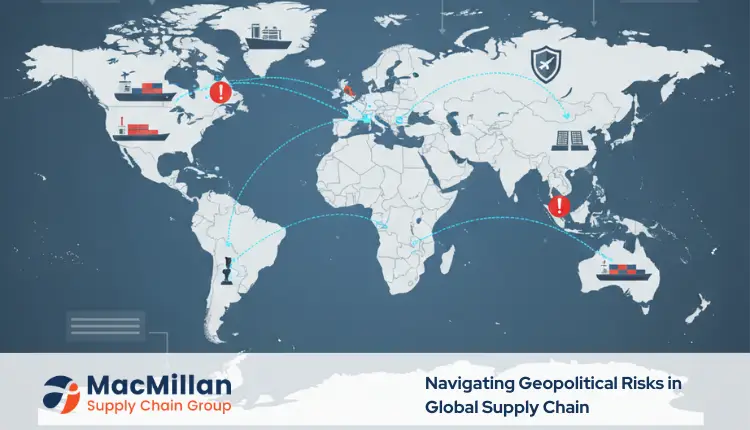
The world’s supply chains are more interconnected and vulnerable than ever in this age of rapid globalization. Geopolitical risks, which range from trade wars and sanctions to cyber threats and regional conflicts, are now a defining challenge for multinational corporations navigating geopolitical risks in global supply chain operations. For Canadian businesses, these risks are more than just news stories; they are actual, day-to-day challenges that have the potential to impair operations, raise expenses, and jeopardize business continuity.
We at Macmillan SCG have personally witnessed how these difficulties affect our clients. As a top Canadian supply chain provider, we help companies handle the challenges of international trade by running warehouses and providing last-mile delivery services all over the nation. The most important risks to Canadian supply chains, the changing geopolitical risk landscape, and tried-and-true methods for enhancing resilience in an unpredictable world will all be covered in this blog.
Growing trade tensions, especially between the US, China, and the EU, have made things unstable for importers and exporters since 2018. The cost structure of goods and raw materials can be abruptly altered by the imposition of tariffs. The implications for Canadian companies are substantial:
Regional conflicts can quickly block important shipping lanes, delay cargo, and raise insurance and security costs, as demonstrated by the Russia-Ukraine war and the unrest in the Middle East and Asia-Pacific. For instance:
These real-world disruptions emphasise the need for navigating geopolitical risks in global supply chain networks with greater agility.
Sanctions regimes are becoming more widespread, focusing on particular businesses, people, and even entire industries in addition to nations. Businesses in Canada have to negotiate a complicated web of:
Supply chains are increasingly being targeted by state-sponsored hackers and cybercriminals as they digitize. The number of ransomware attacks on logistics companies grew by 300% in 2024 alone. Inventory systems can become paralyzed, sensitive data compromised, and operations halted for days or weeks due to a single breach.
With nations enacting carbon border taxes, limiting imports of high-emission goods, and calling for increased supply chain emissions transparency, climate change has become a geopolitical issue. This implies the following for Canadian exporters:
Geographically, economically, and politically, Canada is unique, which presents a unique set of opportunities and challenges for our supply chains.
We at Macmillan SCG have assisted clients in navigating these complexities across a variety of industries, from electronics and automotive to food and pharmaceuticals. Our experience demonstrates that although risks are present, they can be used as opportunities for growth if proactive measures are taken.
Example: New regulations for labor, digital trade, and automotive content were introduced by the US-Mexico-Canada Agreement (USMCA/CUSMA), which superseded NAFTA.
Impact: Businesses were forced to invest in compliance systems, renegotiate contracts, and quickly modify their sourcing.
Example: Exports of specific metals, energy products, and technology were prohibited as a result of sanctions imposed on Russia in response to the conflict in Ukraine.
Impact: Due to shortages, Canadian manufacturers had to look for other suppliers, frequently at a higher cost.
Example: Carriers had to reroute around the Cape of Good Hope due to the Red Sea crisis in 2024, which extended shipments from Asia to North America by up to 20 days.
Impact: The requirement for greater safety stocks, higher shipping expenses, and inventory delays. These factors highlight why navigating geopolitical risks in global supply chain operations is now a strategic necessity.
Example: New regulations in the US and the EU demand evidence that products are not produced using forced labor or in a way that violates environmental regulations.
Impact: Businesses need to invest in clear reporting systems, trace materials, and audit suppliers.
Example: Ransomware attacks on logistics companies have the potential to stop operations, compromise data, and result in fines from the government.
Impact: Strong cybersecurity procedures, staff education, and incident response strategies are required.
At Macmillan SCG, we think that resilience is about thriving in uncertainty rather than just surviving setbacks. Our all-encompassing strategy consists of:
Anticipate increased carbon border taxes, sustainability regulations, and competition for green technologies as nations fight on climate policy.
As countries assert more control over data, supply chains must abide by local cybersecurity and data storage regulations.
New trade routes through the Arctic are being made possible by melting ice, bringing with them both opportunities and new environmental and geopolitical risks.
Global labor scrutiny will only increase, necessitating ethical sourcing and even greater supply chain transparency.
Q1: What is the biggest geopolitical risk that Canadian supply chains are currently facing?
A: Although trade policy volatility, especially US tariffs and sanctions, remains the most immediate threat, worries about cyberattacks and ESG regulations are rapidly intensifying.
Q2: How can I strengthen my supply chain’s ability to withstand geopolitical shocks?
A: Use regional warehousing, invest in real-time risk monitoring, diversify your suppliers, and maintain proactive regulatory compliance.
Q3: Which technological advancements aid in geopolitical risk management?
A: The most important tools are IoT for real-time shipment tracking, blockchain for supplier transparency, and AI for predictive analytics.
Q4: How does Macmillan SCG assist customers in times of need?
A: To reduce interruption, we provide flexible warehousing, crisis response teams, round-the-clock risk monitoring, and quick shipment rerouting.
Although navigating geopolitical risks in global supply chain environments is complex, Canadian businesses can not only survive but also prosper with the correct tactics. No matter what the world throws at our clients, we at Macmillan SCG are dedicated to helping them create supply chains that are flexible, robust, and prepared for the future.
Get in touch with Macmillan SCG right now for a personalized risk assessment and learn how we can assist you in navigating the challenges of international trade if you’re prepared to increase the resilience of your supply chain.
The primary geopolitical risks include trade wars and tariffs, regional conflicts disrupting shipping routes, sanctions and export controls, cyberattacks on supply chain systems, and evolving environmental regulations like carbon border taxes.