The critical 11% vacancy rate in transportation and warehousing that Canada’s logistics industry faces is three times higher than the national average.Nationwide, the Canada warehouse worker shortage is causing supply chain disruptions and e-commerce fulfillment delays. A solution is provided by collaborative robots, or cobots, which can enhance human productivity by up to 30% while fostering safer working conditions. Businesses of all sizes can address labor shortages while increasing operational efficiency with flexible deployment strategies and government funding options like NRC IRAP, which cover up to 45% of implementation costs. This article examines how labor-tech and cobots are revolutionizing Canadian warehouses and opening up new doors for both companies and employees.
Cobots & Labor-Tech: The Answer to Canada’s Warehouse Worker Shortage
One major issue facing Canada’s warehouses is a severe labor shortage. Businesses find it difficult to satisfy customer demands, particularly in light of the e-commerce boom, as vacancy rates in transportation and warehousing reach 11%, which is three times the national average, this highlights the growing scale of the Canada warehouse worker shortage. This shortage affects the entire Canadian logistics industry and is not merely a short-term issue.
However, there is hope for the future. Innovative labor-tech solutions and collaborative robots (cobots) are revolutionizing warehouses nationwide. Cobots are made to work alongside people, increasing productivity without completely replacing workers, in contrast to traditional industrial robots that operate alone.
We’ll look at how these technologies are assisting Canadian companies in overcoming labor shortages, increasing productivity, and establishing safer workplaces in this post. We’ll also examine funding options, realistic implementation strategies, and the prospects for human-robot collaboration in Canada’s changing warehouse environment.
Comprehending the Warehouse Labor Crisis in Canada
With an 11% vacancy rate in the transportation and warehousing sectors, which is much higher than the 3.7% national average, Canada’s warehouse worker shortage has reached critical proportions. Not everyone is equally affected by this crisis; in Ontario alone, there are over 194,000 open positions, which causes supply chain bottlenecks that have an impact on both consumers and businesses. Ontario has been hit especially hard by the Canada warehouse worker shortage, making it the epicenter of warehousing strain in the country.
This shortage is caused by multiple factors. First of all, working in a warehouse frequently entails physically taxing duties in uncomfortable settings, such as hot summers, cold winters, and a need for constant movement. Second, prospective employees are drawn away from logistics positions by rival industries that offer better compensation and working conditions, such as technology and healthcare. Third, fewer young people are pursuing these physically demanding jobs in Canada due to the country’s aging workforce.
Businesses are significantly impacted. Delivery promises are especially difficult for e-commerce fulfillment centers, which have grown significantly since 2020. Businesses lose money and customers become dissatisfied when orders cannot be processed promptly. Smaller Canadian SMEs may experience an existential labor shortage as a result of their incapacity to offer competitive compensation or benefits.
The Actual Price of Unfilled Jobs
Missed deliveries are not the only financial impact. In order to make up for staff shortages, companies report spending an additional 30 to 45 percent on overtime. In the meantime, employee turnover in Canadian warehouses averages 36% per year, with training costs and lost productivity for each replacement coming to about $4,200. These figures demonstrate why, in the fiercely competitive Canadian logistics industry, finding technological solutions to the labor shortage is essential for survival as much as for growth. Ignoring the Canada warehouse worker shortage means risking both revenue and customer satisfaction.
How Cobots Help Solve the Canada Warehouse Worker Shortage
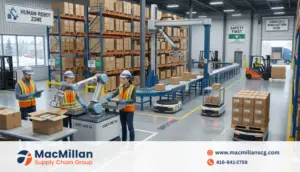
Compared to conventional industrial robots, collaborative robots, or cobots, represent a fundamentally different approach to warehouse automation. Cobots are made especially to work alongside human employees, enhancing rather than completely replacing their skills, whereas traditional robots operate in isolation behind safety cages.
The inherent safety features of cobots are what set them apart. When a worker approaches too closely, they automatically slow down or stop using force-limited actuators and sophisticated sensors to detect human presence. This implies that there is no need for significant reconfiguration or safety precautions when deploying them directly in existing workspaces. These technologies offer real relief from the ongoing Canada warehouse worker shortage.
Types of Cobots Transforming Canadian Warehouses
Several facilities in Ontario use the DOBOT CR20A, which has AI vision systems that allow for real-time defect detection and dynamic worker movement adjustments. It can carry out tasks like palletizing and precise assembly with a payload capacity of 20 kg.
Using LiDAR technology, autonomous mobile robots (AMRs) such as the OTTO 100 move objects up to 150 kg across warehouse floors without the need for fixed routes. AMRs are perfect for Canadian SMEs with limited funding because they don’t require costly floor modifications like traditional AGVs (Automated Guided Vehicles) do. For SMEs tackling the Canada warehouse worker shortage, AMRs provide flexible, cost-effective support that can be scaled without disruption.
Cobots with modular grippers, like those from Geek+’s P Series, can be used for picking tasks and can be modified to handle anything from heavy car parts to delicate cosmetics. Because of its adaptability, a single robot can handle several jobs, increasing return on investment for Canadian companies on a tight budget.
Implementation Strategies and ROI for Canadian Businesses
It is not necessary to completely redesign the warehouse in order to implement cobots. Incremental deployment strategies, which minimize disruption while maximizing returns, are proving to be successful for many Canadian businesses. Before expanding, this strategy enables businesses to test technologies in particular domains.
Workable Deployment Techniques
The most economical place to start is frequently by retrofitting existing infrastructure. For instance, staging carts and OTTO 100 AMRs enable warehouses to automate transport tasks while preserving their existing layouts. Several distribution centers in the Toronto area have seen a 40% reduction in walking time without requiring significant renovations thanks to this technique.
“Goods-to-person” systems can be introduced gradually for picking operations. Serving the Canadian market, Bergen Logistics began by implementing robotic picking stations in a small portion of their warehouse before progressively growing it as the return on investment was demonstrated. Their phased strategy allowed employees to gradually become accustomed to new technologies while processing orders 25% faster. This has become a model approach amid the ongoing Canada warehouse worker shortage, demonstrating how incremental adoption of cobots can yield substantial gains.
The Financial Picture: Expenses and Gains
In Canadian warehouses, the return on investment (ROI) for implementing cobots usually falls between 12 and 24 months. Businesses should budget between $50,000 and $150,000 for basic cobot systems, though upfront costs vary depending on complexity. Nonetheless, a number of factors speed up ROI:
- Up to 45% of the R&D and training expenses associated with automation projects can be covered by government funding through the NRC IRAP. For businesses implementing robotics, the Ontario Manufacturing Initiative provides extra tax advantages.
- By removing the need for significant capital expenditures, leasing models—such as those provided by Locus Robotics, which charge about $8 per hour per robot—make automation affordable for Canadian SMEs with tight budgets.
- Above all, there are significant increases in productivity. Following the deployment of cobots, Canadian companies report throughput increases of 20–30% and error rates in picking operations that can drop by up to 67%.
Workforce Transformation: Training and New Opportunities
The workforce must be prepared for new roles and responsibilities in order for cobot implementation to be successful. Cobots usually change jobs rather than replace them, opening doors for career advancement and upskilling.
Education and Certification Programs
Specialized training is being provided by Canadian educational institutions in response to this need. Robotic fleet management, maintenance, and programming certifications are available from the British Columbia Institute of Technology (BCIT). These initiatives assist warehouse employees in moving from manual labor to technical jobs that pay more and provide better opportunities for advancement.
These organizations collaborate with numerous Canadian businesses to develop unique training initiatives. For instance, a Mississauga distribution center and nearby community colleges worked together to create a 12-week certification program for staff members moving into robot supervision positions. Because employees acquired useful new skills, this human capital investment led to a 22% decrease in turnover.
Evolving Roles in the Wake of the Canada Warehouse Worker Shortage
Human workers transition into roles that capitalize on uniquely human capabilities as cobots perform repetitive, physically taxing tasks. These consist of:
- Robot fleet managers who keep an eye on several cobots and handle anomalies; maintenance specialists who maintain systems in top condition
- Customer service agents who respond to intricate questions; process improvement experts who spot new automation opportunities
Attracting younger employees is another issue facing the Canadian warehouse industry, which this change attempts to solve. Warehouses attract tech-savvy generations entering the workforce by providing jobs that are more focused on technology than just physical labor. Redefining these job roles is crucial in responding to the Canada warehouse worker shortage while keeping operations agile.
Challenges and Limitations of Cobot Implementation
Although cobots appear to be a promising solution to Canada’s shortage of warehouse workers, their successful deployment will require addressing a number of issues:
Technical Obstacles
When integrating cobots with current warehouse management systems, interoperability problems frequently occur. Ineffective communication between proprietary technologies from various vendors may necessitate costly middleware solutions. To link their new AMRs with their old inventory system, for instance, a distribution center in Vancouver had to pay an extra $75,000 for integration software.
Challenges are also posed by environmental factors. Extreme temperature fluctuations are a problem for Canadian warehouses, especially in unheated areas during the winter. In temperatures below -5°C, standard cobots may not function properly, necessitating the use of specialized cold-chain versions that increase equipment costs by 15% to 30%.
Financial Barriers
For many Canadian SMEs, capital constraints are still a major issue even with leasing options and government incentives. For medium-sized businesses, the initial outlay for complete cobot systems can range from $250,000 to $500,000. Even though ROI is usually realized in two years, this initial expense may be unaffordable if financing is not available.
The total cost of ownership also includes maintenance and upgrade expenses. While hardware upgrades and software updates may be required every three to five years to maintain compatibility with changing systems, annual maintenance usually accounts for 8–12% of the initial investment.
Workplace Issues
Concerns regarding job displacement have been voiced by Canadian labor unions. Even though data indicates that cobots create as many jobs as they replace, the skills needed for these new roles differ. Employees who do not have access to training programs might be at a disadvantage in the new workplace.
Implementation may also be hampered by cultural resistance. Workers who are used to more conventional procedures might find it difficult to adjust to robotic coworkers. If change management techniques and clear communication are not used to overcome this resistance, adoption may be slowed and effectiveness may be diminished. Despite its promise, the path to automation isn’t without friction, especially in the context of the Canada warehouse worker shortage.
The Method Used by MacMillan Supply Chain for Cobot Integration
At MacMillan Supply Chain Group, we’ve created all-encompassing plans to assist Canadian companies in overcoming warehouse labor shortages by implementing cobots in an efficient manner. Our strategy tackles the transformation’s human, financial, and technical facets.
Customized Technology Assessment
To determine the ideal ratio of cobots to human employees, we start with a comprehensive assessment of your current operations. This evaluation takes into account your unique workflow, available space, and current systems to suggest solutions that work well together with the least amount of disturbance.
For instance, we discovered that using AMRs for transport tasks would free up human workers for more intricate picking operations while collaborating with a Toronto-based e-commerce fulfillment center that was experiencing a 15% staffing shortage. With only minor adjustments to the current warehouse layout, this focused strategy raised overall throughput by 28%.
Adaptable Implementation Frameworks
We provide adaptable implementation models based on your risk tolerance and budget because we understand the financial limitations that many Canadian businesses face:
- Pilot programs enable you to test technologies in a controlled area of your business before making a full commitment.
- Phased deployment enables you to begin with a small fleet of cobots and grow as ROI is shown.
- Large upfront capital requirements are eliminated by leasing and financing options.
- ROI-based pricing schemes in which a portion of the payment is dependent on actual productivity increases.
We are able to provide competitive pricing while guaranteeing compatibility with your current systems thanks to our partnerships with leading cobot manufacturers. Additionally, we assist clients in navigating government funding options, such as provincial tax incentives and NRC IRAP applications, frequently obtaining 30–45% cost offsets for eligible projects. Our solutions are designed specifically for Canadian businesses feeling the impact of the Canada warehouse worker shortage.
Comprehensive Training and Change Management
Labor issues are solved by people, not by technology. Strong training initiatives created in collaboration with Canadian educational establishments such as BCIT are part of our implementation process. These programs address job security concerns while preparing your workforce for new roles.
Our strategy for change management consists of:
- Transparent explanation of how cobots will complement human labor rather than replace it
- Employees can engage with the technology through interactive demonstration sessions
- Finding “technology champions” on your team to encourage adoption
- Providing ongoing feedback channels to address issues as they emerge
When implementing a picking cobot system for a Vancouver distribution center, we created a 4-week training program that transitioned 85% of manual pickers to robot supervisory roles with higher wages. This approach not only addressed the immediate labor shortage but reduced turnover by 35% in the following year.
Ongoing Support and Optimization
After implementation, our partnership continues. As your company grows, MacMillan Supply Chain offers continuous support to make sure your cobot solution keeps adding value:
- Frequent performance evaluations to find areas for optimization
- Updating software and managing compatibility
- Planning for expansion as your needs increase
- Preventive maintenance to maximize uptime
We assist clients in achieving long-term productivity gains by closely observing system performance and employee input. Based on our continuous analysis and modifications, a Montreal-based client saw an initial efficiency gain of 22% following implementation, which rose to 37% after six months of optimization.
Getting Started with Automation Amid Canada’s Warehouse Worker Shortage
Step 1: Evaluate Your Present Activities
Start by figuring out what your biggest pain points are. Where are the most severe labor shortages occurring? What are the most error-prone processes? Which tasks are making employees tired or injured? The areas where cobots can provide the most immediate benefit will be highlighted by this analysis. Evaluating labor-heavy zones is the first step to navigating the Canada warehouse worker shortage strategically.
Keep a record of your current system architecture, workflows, and space usage. Designing a successful cobot solution that complements rather than interferes with your current operations requires this baseline data.
Step 2: Explore Funding Options
Examine the funding options available to support your initiative before deciding on any technology. Speak with your local NRC IRAP representative about your eligibility for automation project funding. For more tax advantages, look into the Manufacturing Initiative if you live in Ontario.
Smaller businesses should think about partnering with nearby businesses to share implementation expenses and expertise. Many Canadian SMEs have benefited from this strategy by being able to access technologies that would otherwise be unaffordable on their own.
Step 3: Start Small and Scale Strategically
Start with a pilot project in a specific area of your business. This strategy reduces risk while offering worthwhile educational opportunities. For instance, you could begin with one robotic picking station in a high-volume area or one AMR for transport tasks. Pilot deployments allow businesses to experiment with automation while mitigating risks related to the Canada warehouse worker shortage.
Define precise success metrics and a schedule for assessment. Pilot projects typically last three to six months, giving enough information to evaluate performance while keeping things moving forward.
Step 4: Partner with Experts
Successful cobot implementation necessitates specific knowledge of robotics, warehouse operations, and change management. Collaborate with seasoned experts who are familiar with the Canadian logistics landscape rather than trying to navigate this complicated terrain alone.
From the first evaluation to deployment and continuous optimization, MacMillan Supply Chain Group provides comprehensive support for cobot deployment. Dozens of Canadian companies have benefited from our team’s assistance in overcoming labor shortages and increasing operational effectiveness.
Are you prepared to investigate how cobots can revolutionize your warehouse operations? For a free consultation, get in touch with MacMillan Supply Chain Group right now. Our professionals will work with you to pinpoint the most promising automation opportunities in your building and create a tailored implementation strategy that takes into account your unique set of obstacles.
Don’t let a lack of workers restrict your ability to grow. You can overcome these obstacles and set up your company for long-term success in Canada’s changing logistics market with the correct technology and implementation strategy.
Follow us on LinkedIn for real-time tariff updates