
Hybrid Logistics Model: 5 Reasons to Combine In-House + 3PL
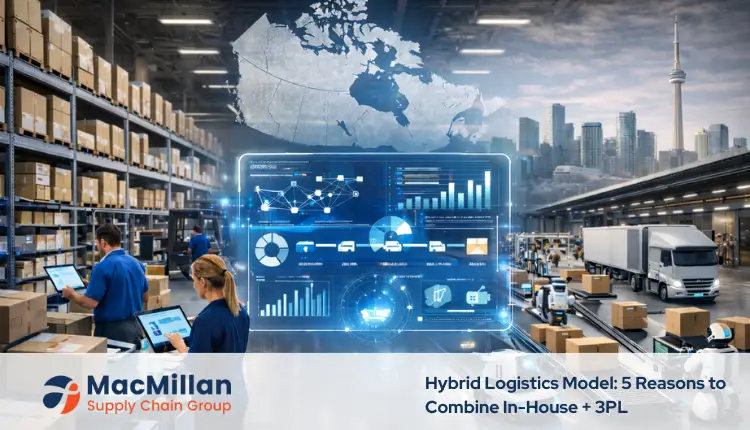
Introduction In today’s evolving logistics landscape, businesses must choose between working with a third-party logistics (3PL) provider or keeping operations fully in-house. But increasingly, the smart move is adopting a hybrid logistics model—a strategy that combines the strengths of both. But what if neither/or isn’t the best option? A powerful trend that combines the capabilities of internal teams with the know-how and technology of a third-party logistics provider is emerging at Macmillan Supply Chain Group. This hybrid logistics approach is a long-term strategic choice rather than merely a short-term fix. And it’s turning out to be the best course of action for a lot of Canadian companies, particularly those dealing with seasonal fluctuations or fast growth. We’ll outline the top five reasons in this post for why you can get the best of both worlds by integrating your internal logistics team with a 3PL provider — particularly one that uses cutting-edge technologies like AI 3PL operating systems. 1. Hybrid Logistics Model =Adaptability Without Losing Command To be honest, it can be a leap of faith to relinquish complete control over your logistics operations. Your team is familiar with your standards, customers, and products. That’s a worthwhile experience. However, there are drawbacks to doing everything in-house, particularly when your company expands or enters new markets. A hybrid strategy can help with that. You can expand your capacity and geographic reach without sacrificing your internal capabilities by outsourcing certain tasks — such as last-mile delivery in a densely populated metro area or warehousing in a new province. The AI 3PL operating systems we implement seamlessly integrate with your current workflows when you work with a partner like Macmillan SCG. This implies that even if our infrastructure handles the execution, your team maintains control over visibility and decision-making. Imagine it as an addition to a beloved house. You’re not going anywhere. Simply put, you’re creating space where it’s most needed. 2. How a Hybrid Logistics Model Helps You Scale Cost Efficiently Keeping everything in-house can quickly become costly. Fixed logistics costs include things like fleet maintenance, warehouse rent, and full-time employees. And when business slows down, those costs don’t just vanish. You can change fixed costs into variable ones with a hybrid model. While relying on your 3PL for specialized services or varying demand, you maintain your core team and assets focused on what they do best. One of our retail clients, for instance, uses Macmillan SCG for regional distribution and returns processing, but manages central fulfillment internally. We increase capacity for them during busy times of the year and then decrease it once things settle down. Their clients receive reliable service, and they save a lot of money on overhead. We can also predict demand trends, optimize resource allocation, and cut waste thanks to AI 3PL operating systems, which helps our hybrid clients save even more money. 3. Boost Supply Chain Visibility With a Hybrid Logistics Model Outsourcing is often associated with a loss of visibility. That isn’t the case in 2025, though, at least not if you’re working with the correct 3PL. Our AI-powered logistics platform at Macmillan SCG offers real-time insights into both internal and external operations and integrates easily with your ERP or WMS. Whether inventory is sitting in your warehouse or en route in ours, you’ll see it all in one place. Our AI 3PL operating systems make it possible to: Track order status from purchase to final delivery Monitor inventory levels across multiple locations View delivery ETAs, exception reports, and carrier performance Get automated notifications when stock needs to be rerouted or replenished That kind of data-sharing means better decisions, faster. Your internal team gains strategic clarity in addition to oversight. Additionally, your clients enjoy more seamless, open service without even being aware that it’s a hybrid operation. 4. Distribute Tasks Using Core Skills Every logistics team has advantages and disadvantages. Perhaps your team excels at local business-to-business distribution but finds it difficult to fulfill orders for online retailers. Or perhaps you are an expert at storage but still struggle with last-mile delivery in rural areas. A hybrid approach enables you to divide responsibilities purposefully, as opposed to hiring for every niche need or attempting to push your team beyond its comfort zone. This is how it might appear: In-house: Manage expensive shipments, delicate goods, or packaging that is essential to the brand. 3PL partner: Oversee cross-border logistics, same-day fulfillment, and excess inventory. At Macmillan SCG, we routinely work with clients who want to retain specific logistics functions internally — and we build our services around that. Our AI-driven systems ensure that our portion of the supply chain aligns with your processes, customer SLAs, and performance metrics. It has nothing to do with changing your team. Giving them a logistics partner who can cover the gaps and improve performance is the goal. 5. Hybrid Logistics Model = Advanced Tech Without High Investment The harsh reality is that the logistics sector is evolving quickly, and it costs money to stay up to date with new developments. It can take months and a six-figure budget to implement sophisticated robotics, route optimization tools, or real-time tracking. Investing in all of that internally is simply not feasible for many businesses. However, working with a forward-thinking 3PL like Macmillan SCG gives you immediate access to effective tools like: AI-powered 3PL operating systems that automate inventory control and forecast demand Real-time machine learning models that modify delivery routes in response to traffic and weather conditions Up to 65% faster picking and packing with robotics and warehouse automation Better yet, our facilities have already tested, improved, and implemented these technologies. No learning curve. No delays. Just better performance — from day one. This means your hybrid model isn’t just a cost-saving move. It’s a chance to upgrade your supply chain while avoiding the sunk cost of building from scratch. Real Clients. Real Hybrid Wins. Here’s a brief illustration: All logistics used to be managed internally by one of our B2C clients, an Ontario-based skincare brand. However, their staff was overworked during the pandemic
How to Choose the Right 3PL Fulfillment Center Location
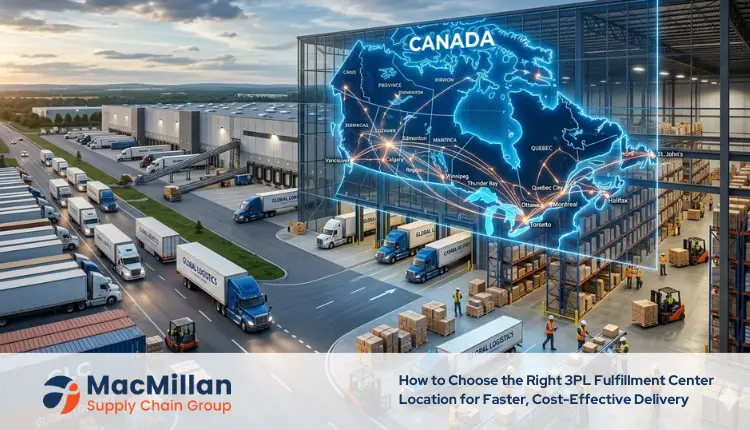
A Quick Summary and Overview Choosing the right 3PL fulfillment center location is a strategic decision that directly impacts your shipping costs, delivery times, and overall customer satisfaction. This comprehensive guide explores the five essential factors businesses must evaluate when selecting optimal warehouse locations: geographic proximity to customers, transportation infrastructure, technology integration capabilities, cost considerations, and scalability potential. Whether you’re expanding your e-commerce operation or optimizing your existing supply chain, understanding these key factors will help you make informed decisions that support your business growth and enhance your competitive advantage in the marketplace. Why Your 3PL Fulfillment Center Location Matters More Than You Think In today’s fast-paced business environment, where next-day and same-day delivery options have become the norm, the strategic placement of your 3PL fulfillment center can make or break your customer experience. But how do you determine the ideal location for your warehousing and distribution operations? At MacMillan Supply Chain Group, we’ve helped countless businesses optimize their fulfillment networks across Canada and beyond. We’ve learned that successful 3PL fulfillment center selection isn’t just about finding available space—it’s about making a strategic decision that balances multiple factors to create a competitive advantage. Whether you’re looking for fulfillment services in Canada or exploring cross-border shipping options, understanding these five key evaluation factors will help you make informed decisions that drive efficiency, reduce costs, and ultimately delight your customers. Geographic Proximity to Your Customer Base The most fundamental factor in selecting a 3PL fulfillment center location is proximity to your customers. Why? Because being closer to your end consumers directly translates to faster delivery times and reduced shipping costs. Canadian businesses often face unique challenges due to the country’s vast geography and dispersed population centers. If most of your customers are concentrated in Ontario, a fulfillment center in Toronto makes perfect sense. Similarly, if you serve Western Canada, a fulfillment center in Vancouver provides strategic advantages. When analyzing customer proximity, consider these elements: Customer density maps: Where are your customers most concentrated? High-density areas often justify dedicated fulfillment centers. Shipping zones: Carriers like Canada Post and FedEx use zone-based pricing. The fewer zones a package crosses, the lower your shipping costs. Delivery time expectations: If you promise two-day delivery, your fulfillment center must be positioned to meet that commitment. For businesses serving both Canadian and U.S. markets, cross-border shipping considerations become crucial. A strategically located warehouse near major border crossings can significantly reduce customs delays and transportation costs. Remember, the goal isn’t necessarily to be close to your business headquarters—it’s to be close to your customers. Many successful e-commerce companies operate fulfillment centers hundreds of kilometers from their main offices to optimize their distribution networks. Transportation Infrastructure and Accessibility Even the most perfectly positioned 3PL fulfillment center won’t deliver value if it lacks proper transportation connections. When evaluating potential locations, transportation infrastructure should be a top priority. Look for these key transportation elements: The quality of local roads and seasonal considerations also matter. Some regions experience severe winter conditions that can impact delivery reliability. A fulfillment center in Toronto or Vancouver typically offers more consistent year-round accessibility than more remote locations. For businesses engaged in cross-border logistics fulfillment, proximity to major border crossings like Windsor-Detroit, Niagara Falls, or Vancouver-Seattle corridors can streamline customs processes and reduce transit times. Don’t overlook last-mile delivery solutions in CA either. Urban fulfillment centers may face traffic congestion but offer faster final delivery, while suburban locations might provide better highway access but longer last-mile routes. Technology Integration and Warehouse Management Systems Modern 3PL fulfillment centers are technology-driven operations. When selecting a location, the technological capabilities of the facility should factor heavily into your decision-making process. Leading Canadian 3PL solutions providers offer advanced warehouse management systems (WMS) that provide: Real-time inventory visibility Order tracking capabilities Integration with your e-commerce platforms Automated picking and packing processes Detailed reporting and analytics The technology infrastructure at your chosen location directly impacts fulfillment accuracy, processing speed, and overall operational efficiency. A technologically advanced fulfillment center in Vancouver or Toronto might command higher rates but deliver superior performance that justifies the investment. When evaluating technology capabilities, ask potential 3PL partners: How does their WMS integrate with your existing systems? What level of visibility will you have into inventory and orders? What automation technologies are deployed in the facility? How do they handle system upgrades and maintenance? What redundancies exist to prevent downtime? For e-commerce fulfillment in CA, seamless integration between your online store and the 3PL’s systems is particularly crucial. The right technology stack enables real-time inventory updates, automated order processing, and efficient returns management—all essential components of a positive customer experience. Remember that technology capabilities can vary significantly between facilities, even within the same 3PL network. Cost Structure and Economic Considerations While strategic location and technological capabilities are crucial, cost remains a fundamental consideration when selecting a 3PL fulfillment center. Understanding the complete cost structure helps you make economically sound decisions. When evaluating affordable fulfillment centers in Canada, consider these cost factors: Base storage costs: How much will you pay per square foot or pallet position? Order processing fees: What are the picking, packing, and shipping charges? Value-added service costs: Are there additional fees for kitting, custom packaging, or returns processing? Minimum commitments: Is there a monthly minimum charge regardless of volume? Seasonal surcharges: Do rates increase during peak periods? Regional economic variations can significantly impact your total costs. While warehouse space in downtown Toronto commands premium rates, facilities in surrounding areas may offer substantial savings while maintaining excellent transportation access. Labor costs also vary by region. Areas with competitive job markets may have higher wage requirements but often provide access to a more skilled workforce. This is particularly important for fulfillment operations requiring specialized handling or technical expertise. For businesses utilizing cross-border shipping from Canada, understanding the complete landed cost picture—including duties, taxes, and customs brokerage fees—is essential for accurate financial planning. Don’t focus exclusively on the lowest base rate. A slightly higher-priced facility with superior efficiency, lower error
Selecting 3PL Fulfillment Center Locations: 5 Key Factors to Evaluate

A Quick Summary and Overview Choosing the right 3PL fulfillment center location is a strategic decision that directly impacts your shipping costs, delivery times, and overall customer satisfaction. This comprehensive guide explores the five essential factors businesses must evaluate when selecting optimal warehouse locations: geographic proximity to customers, transportation infrastructure, technology integration capabilities, cost considerations, and scalability potential. Whether you’re expanding your e-commerce operation or optimizing your existing supply chain, understanding these key factors will help you make informed decisions that support your business growth and enhance your competitive advantage in the marketplace. Why Your 3PL Fulfillment Center Location Matters More Than You Think In today’s fast-paced business environment, where next-day and same-day delivery options have become the norm, the strategic placement of your 3PL fulfillment center can make or break your customer experience. But how do you determine the ideal location for your warehousing and distribution operations? At MacMillan Supply Chain Group, we’ve helped countless businesses optimize their fulfillment networks across Canada and beyond. We’ve learned that successful 3PL fulfillment center selection isn’t just about finding available space—it’s about making a strategic decision that balances multiple factors to create a competitive advantage. Whether you’re looking for fulfillment services in Canada or exploring cross-border shipping options, understanding these five key evaluation factors will help you make informed decisions that drive efficiency, reduce costs, and ultimately delight your customers. Geographic Proximity to Your Customer Base The most fundamental factor in selecting a 3PL fulfillment center location is proximity to your customers. Why? Because being closer to your end consumers directly translates to faster delivery times and reduced shipping costs. Canadian businesses often face unique challenges due to the country’s vast geography and dispersed population centers. If most of your customers are concentrated in Ontario, a fulfillment center in Toronto makes perfect sense. Similarly, if you serve Western Canada, a fulfillment center in Vancouver provides strategic advantages. When analyzing customer proximity, consider these elements: Customer density maps: Where are your customers most concentrated? High-density areas often justify dedicated fulfillment centers. Shipping zones: Carriers like Canada Post and FedEx use zone-based pricing. The fewer zones a package crosses, the lower your shipping costs. Delivery time expectations: If you promise two-day delivery, your fulfillment center must be positioned to meet that commitment. For businesses serving both Canadian and U.S. markets, cross-border shipping considerations become crucial. A strategically located warehouse near major border crossings can significantly reduce customs delays and transportation costs. Remember, the goal isn’t necessarily to be close to your business headquarters—it’s to be close to your customers. Many successful e-commerce companies operate fulfillment centers hundreds of kilometers from their main offices to optimize their distribution networks. Transportation Infrastructure and Accessibility Even the most perfectly positioned 3PL fulfillment center won’t deliver value if it lacks proper transportation connections. When evaluating potential locations, transportation infrastructure should be a top priority. Look for these key transportation elements: The quality of local roads and seasonal considerations also matter. Some regions experience severe winter conditions that can impact delivery reliability. A fulfillment center in Toronto or Vancouver typically offers more consistent year-round accessibility than more remote locations. For businesses engaged in cross-border logistics fulfillment, proximity to major border crossings like Windsor-Detroit, Niagara Falls, or Vancouver-Seattle corridors can streamline customs processes and reduce transit times. Don’t overlook last-mile delivery solutions in CA either. Urban fulfillment centers may face traffic congestion but offer faster final delivery, while suburban locations might provide better highway access but longer last-mile routes. Technology Integration and Warehouse Management Systems Modern 3PL fulfillment centers are technology-driven operations. When selecting a location, the technological capabilities of the facility should factor heavily into your decision-making process. Leading Canadian 3PL solutions providers offer advanced warehouse management systems (WMS) that provide: Real-time inventory visibility Order tracking capabilities Integration with your e-commerce platforms Automated picking and packing processes Detailed reporting and analytics The technology infrastructure at your chosen location directly impacts fulfillment accuracy, processing speed, and overall operational efficiency. A technologically advanced fulfillment center in Vancouver or Toronto might command higher rates but deliver superior performance that justifies the investment. When evaluating technology capabilities, ask potential 3PL partners: How does their WMS integrate with your existing systems? What level of visibility will you have into inventory and orders? What automation technologies are deployed in the facility? How do they handle system upgrades and maintenance? What redundancies exist to prevent downtime? For e-commerce fulfillment in CA, seamless integration between your online store and the 3PL’s systems is particularly crucial. The right technology stack enables real-time inventory updates, automated order processing, and efficient returns management—all essential components of a positive customer experience. Remember that technology capabilities can vary significantly between facilities, even within the same 3PL network. Cost Structure and Economic Considerations While strategic location and technological capabilities are crucial, cost remains a fundamental consideration when selecting a 3PL fulfillment center. Understanding the complete cost structure helps you make economically sound decisions. When evaluating affordable fulfillment centers in Canada, consider these cost factors: Base storage costs: How much will you pay per square foot or pallet position? Order processing fees: What are the picking, packing, and shipping charges? Value-added service costs: Are there additional fees for kitting, custom packaging, or returns processing? Minimum commitments: Is there a monthly minimum charge regardless of volume? Seasonal surcharges: Do rates increase during peak periods? Regional economic variations can significantly impact your total costs. While warehouse space in downtown Toronto commands premium rates, facilities in surrounding areas may offer substantial savings while maintaining excellent transportation access. Labor costs also vary by region. Areas with competitive job markets may have higher wage requirements but often provide access to a more skilled workforce. This is particularly important for fulfillment operations requiring specialized handling or technical expertise. For businesses utilizing cross-border shipping from Canada, understanding the complete landed cost picture—including duties, taxes, and customs brokerage fees—is essential for accurate financial planning. Don’t focus exclusively on the lowest base rate. A slightly higher-priced facility with superior efficiency, lower error
Mastering Last Mile Fulfilment: The Key to Winning in E-Commerce Logistics
A Quick Summary and Overview In today’s experience-driven economy, where consumer loyalty hinges on speed and convenience, the final leg of your delivery process—last mile fulfilment—can either elevate or erode your brand. Particularly for food and beverage brands and fast-moving consumer goods (FMCGs), the last mile is where trust is tested and customer expectations peak. MacMillan Supply Chain Group helps businesses meet these expectations with scalable, AI-powered logistics solutions that transform the final mile into a competitive advantage. What is Last Mile Fulfilment and Why Does It Matter? Last mile fulfilment refers to the final step in a product’s journey—from warehouse to customer doorstep. Despite being the shortest segment, it’s often the most expensive and complex, accounting for over 50% of total logistics costs, as highlighted in Capgemini’s Last Mile Report. This step has a direct impact on customer satisfaction, loyalty, and perceived product value. According to McKinsey & Company, 70% of online shoppers consider delivery speed and reliability crucial to their buying decision. MacMillan ensures 90% of Forward Sortation Areas (FSAs) in Canada are covered by next-day delivery through a dedicated fleet of over 3,000 drivers, processing 3.1 million shipments annually. Common Barriers in Last Mile Delivery Urban congestion and rising fuel costs Failed or late deliveries leading to perishables loss Lack of visibility into in-transit shipments Pressure to meet tight SLAs for DTC and retail customers Fragmented 3PL services leading to inconsistent brand experience At MacMillan, we address these with predictive analytics, AI-optimized routes, and real-time tracking technologies that keep operations transparent and aligned with your service standards. Explore our transportation technology Why MacMillan SCG is Built for Complex Last Mile Logistics Our last mile framework is built for agility and scale: High Lane Densities: Reduce delivery cost per unit across major markets Nationwide Network: Access to 45+ cross-dock hubs and metro-to-rural reach Big & Bulky Fulfilment: Full-service delivery for CPGs, appliances, and more SLA-Centric Execution: We deliver on your commitments with precision Need specialized fulfilment like temperature-controlled delivery or white-glove service for high-value goods? Explore our specialized solutions Integrated Fulfilment Backed by a Robust WMS What sets us apart is full-stack fulfilment integration. We connect: Warehousing and Distribution Order Fulfilment Services Container Destuffing All operations are unified under our Mantis-powered Warehouse Management System (WMS), providing: Real-time inventory tracking 99.56% accuracy 99% OTIF (on-time in-full) shipments Over 350 KPI metrics to inform your decisions Built for Food & Beverage, Retail, and DTC Brands MacMillan’s fulfilment architecture is purpose-built for fast-moving industries: Perishables: Time-sensitive, condition-controlled delivery Beverages & Supplements: Bulk order management with FIFO/FEFO logic Retail & Apparel: White-label branding and SKU-level tracking DTC E-commerce: Seamless integrations with Shopify, Amazon, WooCommerce, and more According to the National Retail Federation (NRF), 83% of consumers expect full control over delivery times, locations, and tracking—which places even more pressure on your last mile strategy. Learn how we support high-growth sectors Is Your Business Ready to Scale with Smarter Logistics? Switching logistics providers can feel risky—but at MacMillan, we make it seamless. Our fast-track migration model includes: Zero-downtime onboarding Data-driven WMS integration Dedicated support throughout testing, go-live, and scaling Discover our onboarding process Transform Your Last Mile into a Brand Asset In a world where logistics is a major brand differentiator, last mile fulfilment can’t be an afterthought. It must be optimized, visible, and reliable. By partnering with MacMillan SCG, you empower your operations with: A proven nationwide delivery network Tech-enabled, insight-driven execution Flexible fulfilment models tailored to your product and market Get a personalized quote Contact our team to explore a solution Further Reading How to Improve Last Mile Delivery Optimizing Last Mile Delivery for Heavy Goods Advancements in Last Mile Delivery