How to Make Big and Bulky Last-Mile Work For You
Hats off to you for always wanting to make life…
Hats off to you for always wanting to make life…
You’ve sent your product out for delivery, they’ve received it,…
In the fast-evolving landscape of global trade and e-commerce, supply…
Following its success with Prime delivery and becoming the business…
Many brands do not realize they have outgrown their 3PL until service problems start affecting customer experience, retail relationships, and internal operations. What once worked at a smaller scale can become a growth bottleneck as SKU counts rise, channels expand, compliance requirements tighten, and promotions create higher operational pressure. The issue is not always that your current provider is bad. It is often that your business has evolved faster than their capabilities. If your team is dealing with delayed orders, weak visibility, compliance issues, slow communication, or trouble scaling during promotions, it may be time to reassess your logistics partner. MacMillan SCG is built for brands that need retail-ready warehousing, transportation coordination, real-time visibility, value-added services, and scalable support across channels.
A 3PL partnership should make growth easier. It should reduce friction, improve visibility, and help your team move faster with more confidence.
But when your provider can no longer keep pace, the symptoms show up everywhere.
Inventory issues become more common. Customer complaints rise. Retail requirements feel harder to meet. Internal teams spend more time chasing updates, fixing exceptions, and working around the provider instead of focusing on growth.
This is one of the most common inflection points for scaling brands. The challenge is that many businesses wait too long to act. They keep trying to patch operational problems that are actually signs of partner misalignment.
If your 3PL was built for where your business used to be, not where it is going, you may already be paying for that gap in lost time, margin, and brand trust.
Brands usually outgrow a 3PL for one of four reasons:
A partner that handled simple DTC orders may struggle once you add retail compliance, subscription kits, launches, returns, and multi-channel fulfillment. Likewise, a provider that offered enough support at low volume may become too slow, too manual, or too opaque as your business scales.
MacMillan’s site is positioned around solving exactly these scaling challenges through warehousing, transportation, ecommerce fulfillment, value-added services, integrations, and KPI-driven visibility.
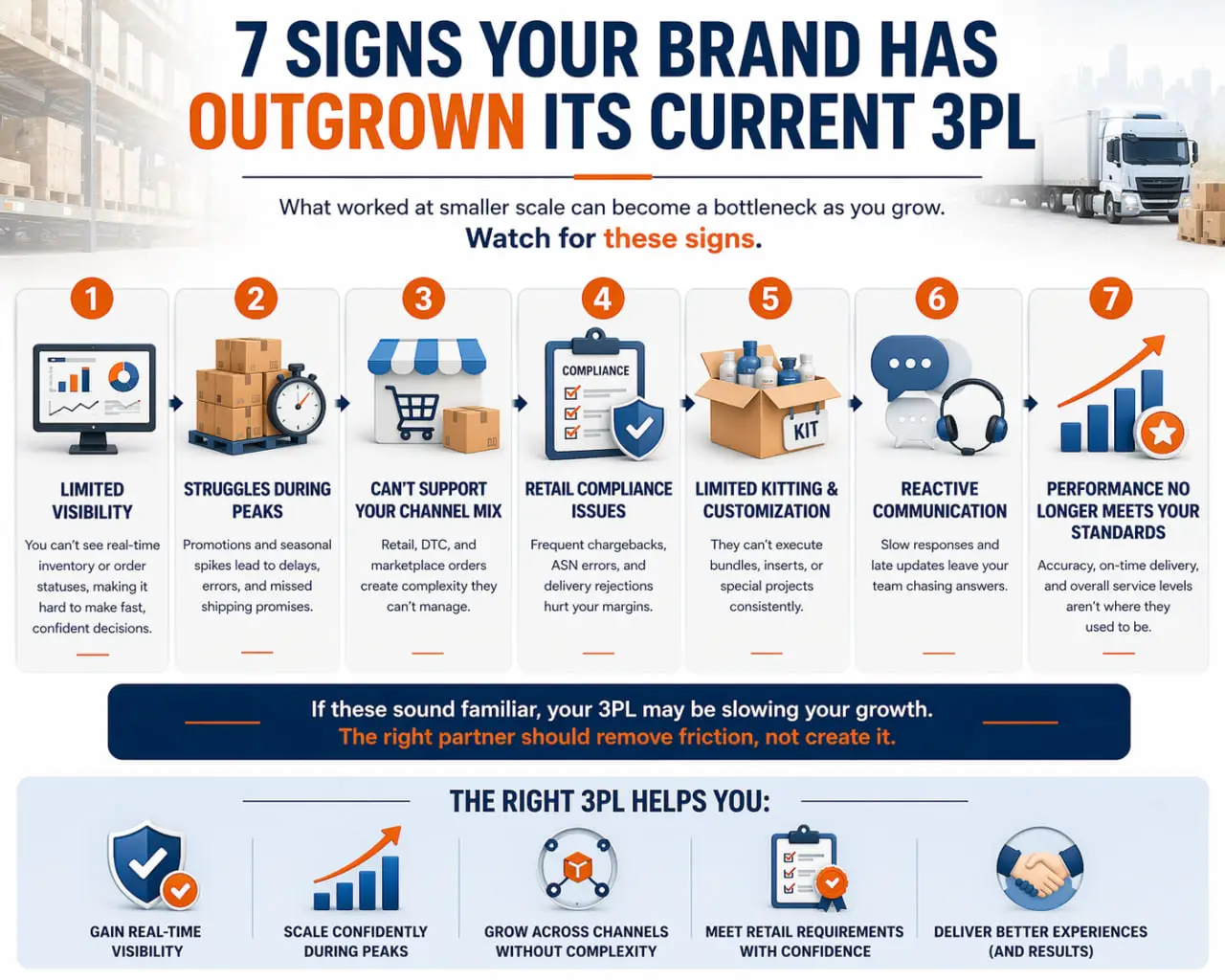
If your team still waits for spreadsheets, manual updates, or delayed exception reports, your operation is already behind. As volume grows, visibility becomes essential for managing stock, customer service, launches, and replenishment.
A modern 3PL should give you better control over:
MacMillan emphasizes real-time visibility through its WMS-backed systems, client portal access, and performance tracking, giving brands more control over inventory and fulfillment decisions.
A 3PL that performs adequately during regular weeks may break under pressure when volumes spike. This often shows up during seasonal campaigns, product launches, holiday peaks, or influencer-driven demand surges.
Warning signs include:
MacMillan highlights support for promotional volumes, seasonal peaks, special campaigns, and launch readiness across its warehousing and value-added service pages.
Many brands start with one channel and later expand into retail, marketplaces, wholesale, or subscription models. That adds complexity fast.
If your 3PL is built only for simple parcel fulfillment, you may run into issues with:
MacMillan positions itself as a multi-channel logistics partner with support for retail, ecommerce, and value-added workflows under one roof.
Chargebacks, rejections, missed ASNs, incorrect labels, and poor pallet builds are not just execution mistakes. They are signs that your provider may not be equipped for retail precision.
MacMillan’s warehousing capabilities specifically mention compliance with retailer requirements including pallet height, label requirements, carton orientation, and ASN accuracy, helping brands reduce chargebacks and delivery rejections.
If your current 3PL is creating retail friction instead of reducing it, that is a major signal that the partnership is no longer the right fit.
As brands grow, operations become less standardized. You may need bundles, inserts, seasonal kits, subscription assemblies, gift packaging, relabeling, or retailer-specific configurations.
If your provider treats these needs as disruptions instead of built-in capabilities, growth gets harder than it should be.
MacMillan’s value-added services include kitting, inserts, promotional packaging, GS1 barcodes, bilingual packaging, relabeling, and display assembly, which are all useful for brands running more complex programs.
A strong 3PL should not wait for you to discover a problem. It should flag issues early, communicate clearly, and give your team confidence that operations are under control.
You may have outgrown your current provider if:
MacMillan’s positioning emphasizes transparency, honest reporting, proactive updates, and partnership-oriented service, which is exactly what growth-stage brands need from a logistics provider.
At a certain point, the question becomes simple: does this provider still support the brand experience and operating discipline your business needs?
That includes:
MacMillan’s KPI positioning includes 99.56% inventory accuracy, 99.5% perfect order rate, 99% on-time and in-full shipments, and 99.9% shipping accuracy. Those are the kinds of measurable benchmarks brands should look for when evaluating whether a provider can support the next stage of growth.
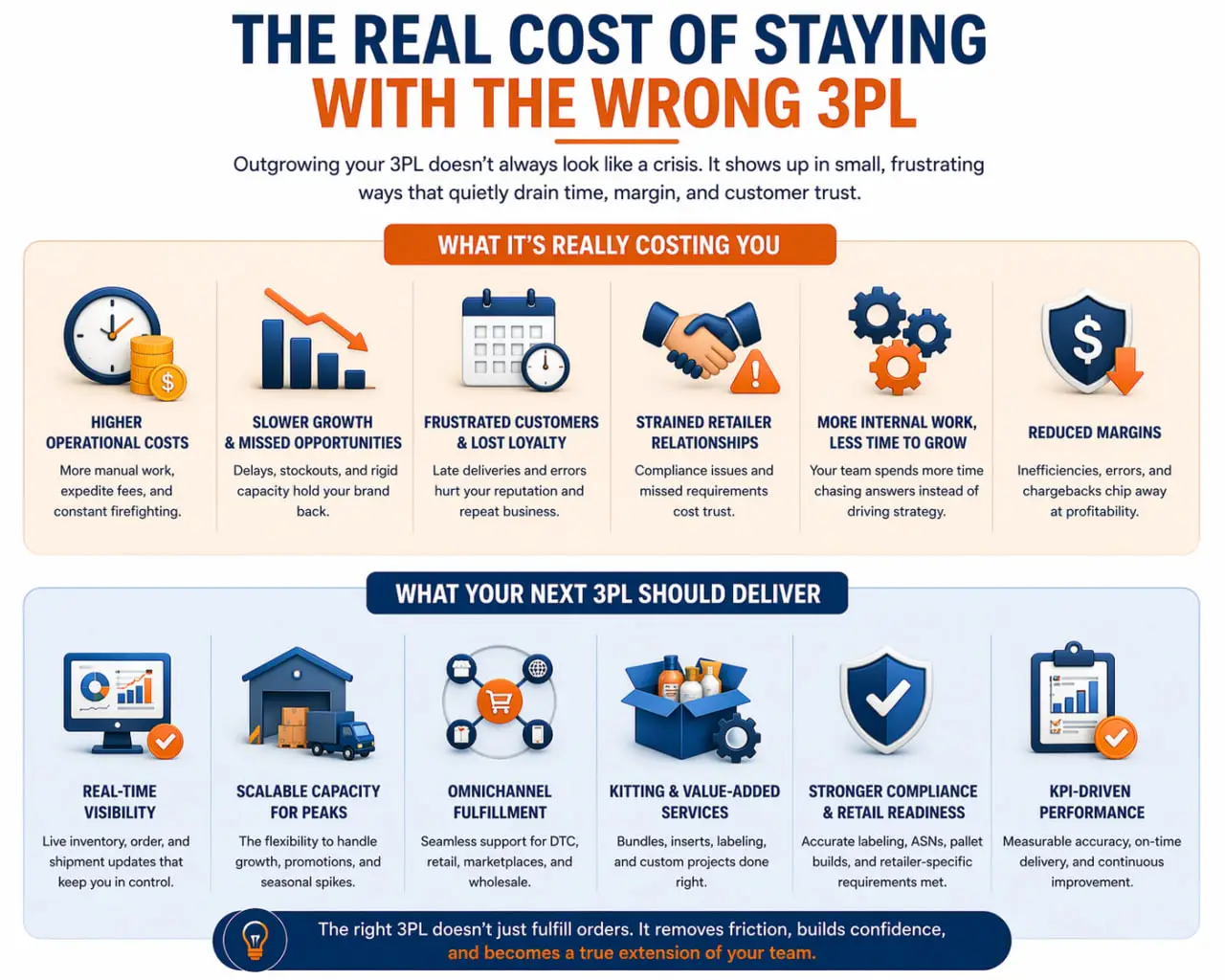
Many brands delay switching because changing 3PLs feels disruptive. But staying with the wrong provider often costs more over time.
The hidden costs usually include:
A provider should reduce operational drag, not create it.
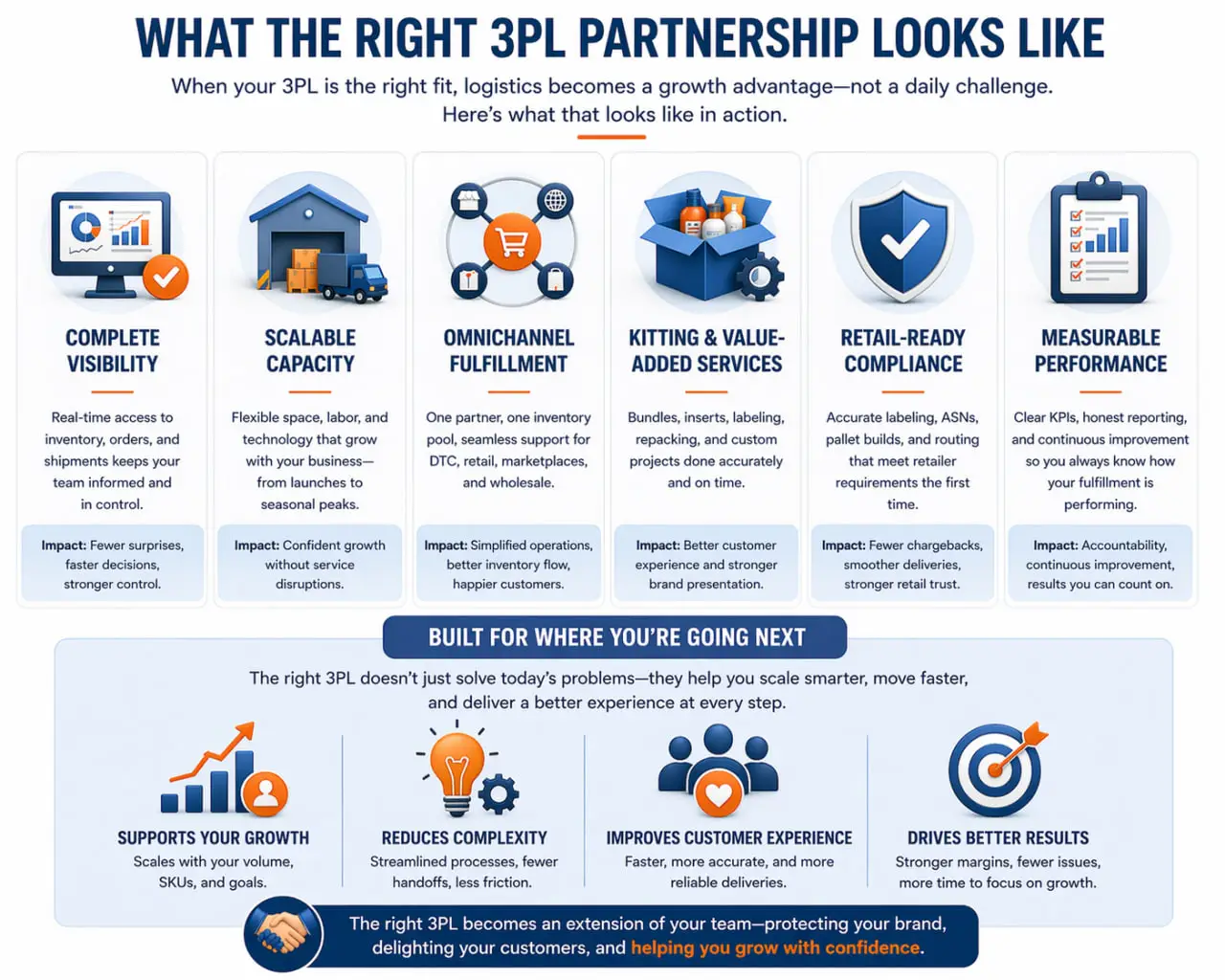
If you recognize several of the warning signs above, your next partner should offer more than storage and shipping. Look for a provider that can support:
MacMillan’s service pages reflect this kind of integrated model, with warehousing, transportation, ecommerce fulfillment, integrations, and value-added services designed to work together.
MacMillan SCG is positioned for brands that need more than basic order fulfillment. The company’s site highlights:
That makes MacMillan a strong fit for brands moving from simple fulfillment needs into more complex, multi-channel growth.
Outgrowing a 3PL is not a failure. It is often a sign that your business is advancing.
The real risk is staying with a partner that no longer matches your operational needs.
If your current provider is limiting visibility, slowing growth, creating compliance issues, or struggling with scale, it may be time to move to a 3PL built for where your business is headed next.
MacMillan SCG helps brands scale with better visibility, stronger compliance, retail-ready execution, and integrated fulfillment support across channels. If your team is working around your 3PL instead of growing with it, this is the right time to reassess your logistics partnership.
Talk to MacMillan SCG about building a fulfillment model that supports your next stage of growth with accuracy, transparency, and operational confidence.