Amazon’s Seller Fulfilled Prime: A Guide to 10x your Sales.
Following its success with Prime delivery and becoming the business…
Following its success with Prime delivery and becoming the business…
In the fast-evolving landscape of global trade and e-commerce, supply…
Partnering with a third-party logistics (3PL) provider like MacMillan Supply…
Customers prioritize receiving their orders securely, accurately, and on time,…
Retail chargebacks are not just annoying deductions on an invoice. They are a direct signal that something in your supply chain is breaking down before your product reaches the shelf. For FMCG, wellness, beauty, pet care, and home care brands, the most common causes are preventable: incorrect labeling, missed ASNs, non-compliant pallet builds, incomplete shipments, and missed delivery windows. Retailers are tightening performance expectations, and brands that miss the mark risk more than penalties. They risk weaker retailer relationships, poor supplier scorecards, and lost growth opportunities. MacMillan Supply Chain Group helps brands reduce that risk through retail-ready warehousing, compliant labeling, real-time visibility, and transportation execution built for high-precision consumer goods operations across Canada.
One mislabeled pallet can trigger a chargeback. One missed ASN can create confusion at the receiving dock. One late or early shipment can result in a rejected delivery and a damaged retailer relationship. That is why chargeback prevention is no longer a back-office issue. It is a growth issue.
Retailers and wholesalers continue to hold suppliers to strict fulfillment standards. When brands miss retailer routing guide requirements, send incomplete orders, or fail to hit delivery expectations, the costs add up quickly through penalties, delays, rework, and lost trust. Competitor content that is performing well in 2025 and 2026 is speaking directly to this reality with practical, operational guidance, not generic logistics commentary.
For brands selling into major retail channels, the goal is not simply shipping product. The goal is shipping product in a way that is accurate, compliant, on time, and easy for retailers to receive. That is where MacMillan SCG creates value.
Retail chargebacks are financial penalties retailers impose when orders fail to meet operational requirements. Common triggers include incorrect labeling, missed ASNs, incomplete shipments, and late or early deliveries. Poor performance can also affect retailer scorecards, preferred supplier status, and future order volume.
In practice, most chargebacks do not start at the retail dock. They start earlier in the process:
When OTIF and fill rates are strong, brands spend less on expediting and face fewer chargebacks. Shopify’s current B2B KPI guidance highlights OTIF and fill rate as two of the clearest indicators of supply chain health, noting that stronger performance reduces penalties and helps retain customers.
Retail operations are becoming less forgiving, not more. Brands are expected to support omnichannel demand, tighter replenishment cycles, and retailer-specific compliance standards all at once. At the same time, more content from leading ecommerce and fulfillment brands is emphasizing visibility, cross-functional coordination, and logistics strategy as competitive differentiators in 2026.
That means a reactive approach is expensive. If your team only finds out about a compliance issue after a retailer dispute, you are already paying for it in some combination of margin loss, internal rework, delayed sell-through, and strained relationships.
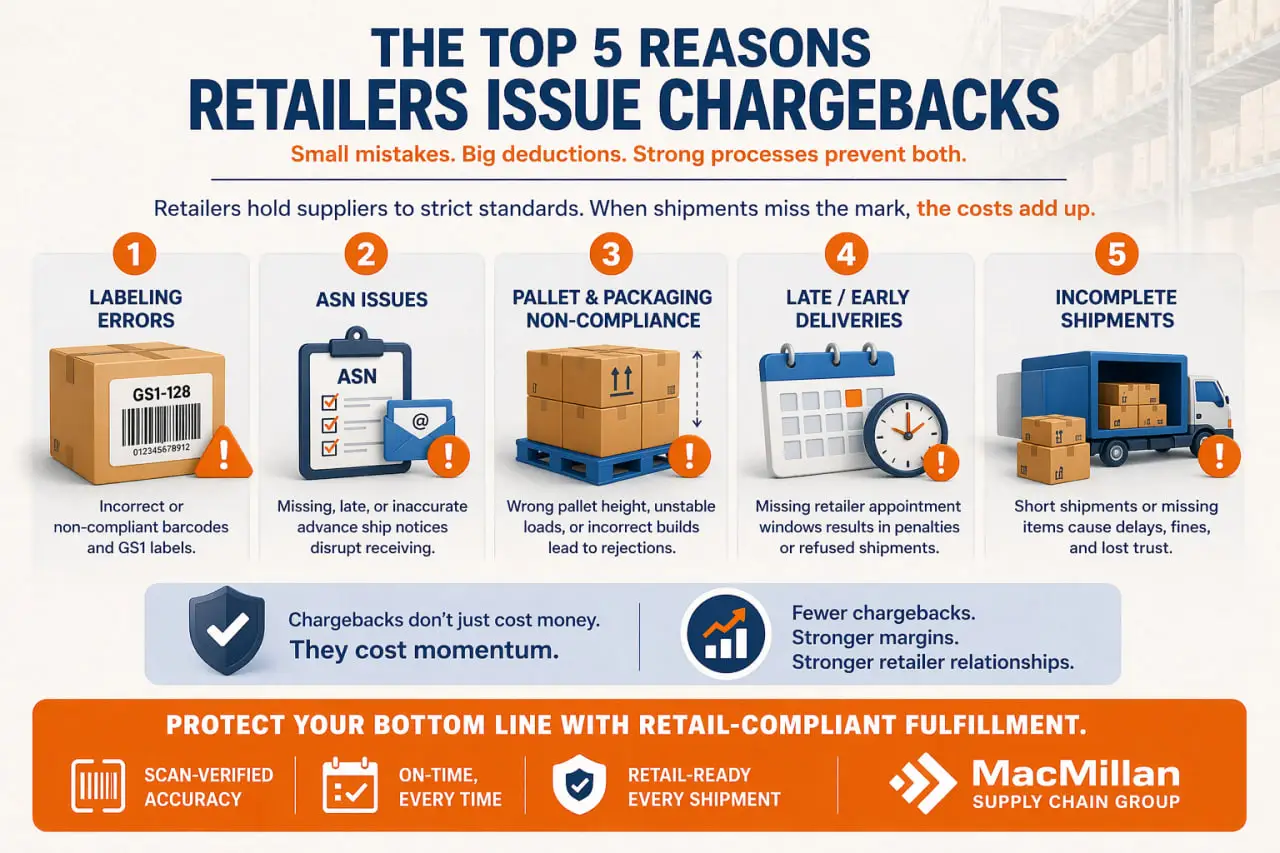
Retailers often require strict barcode, carton, pallet, and GS1-compliant labeling standards. A small labeling mistake can delay receiving or trigger a penalty. Metro Supply Chain’s B2B fulfillment guidance highlights labeling and routing guide compliance as a major challenge for brands supplying retail channels.
An ASN is not just a paperwork step. It prepares the retailer for inbound receipt. When ASN data is wrong or delayed, receiving teams lose trust in the shipment before it is even unloaded. Competitor guidance consistently points to missed ASNs as a chargeback trigger.
Wrong pallet height, carton orientation, packaging configuration, or load stability can cause rejections at the dock. These are execution failures, not transportation failures.
Retail appointments matter. Missing the delivery window can create downstream receiving issues and result in penalties or refusal. OTIF remains one of the core measures retailers and brands use to judge fulfillment performance.
Even when a truck arrives on time, missing units can still damage retailer confidence and affect fill rate performance. High fill rates reduce friction, penalties, and service failures.
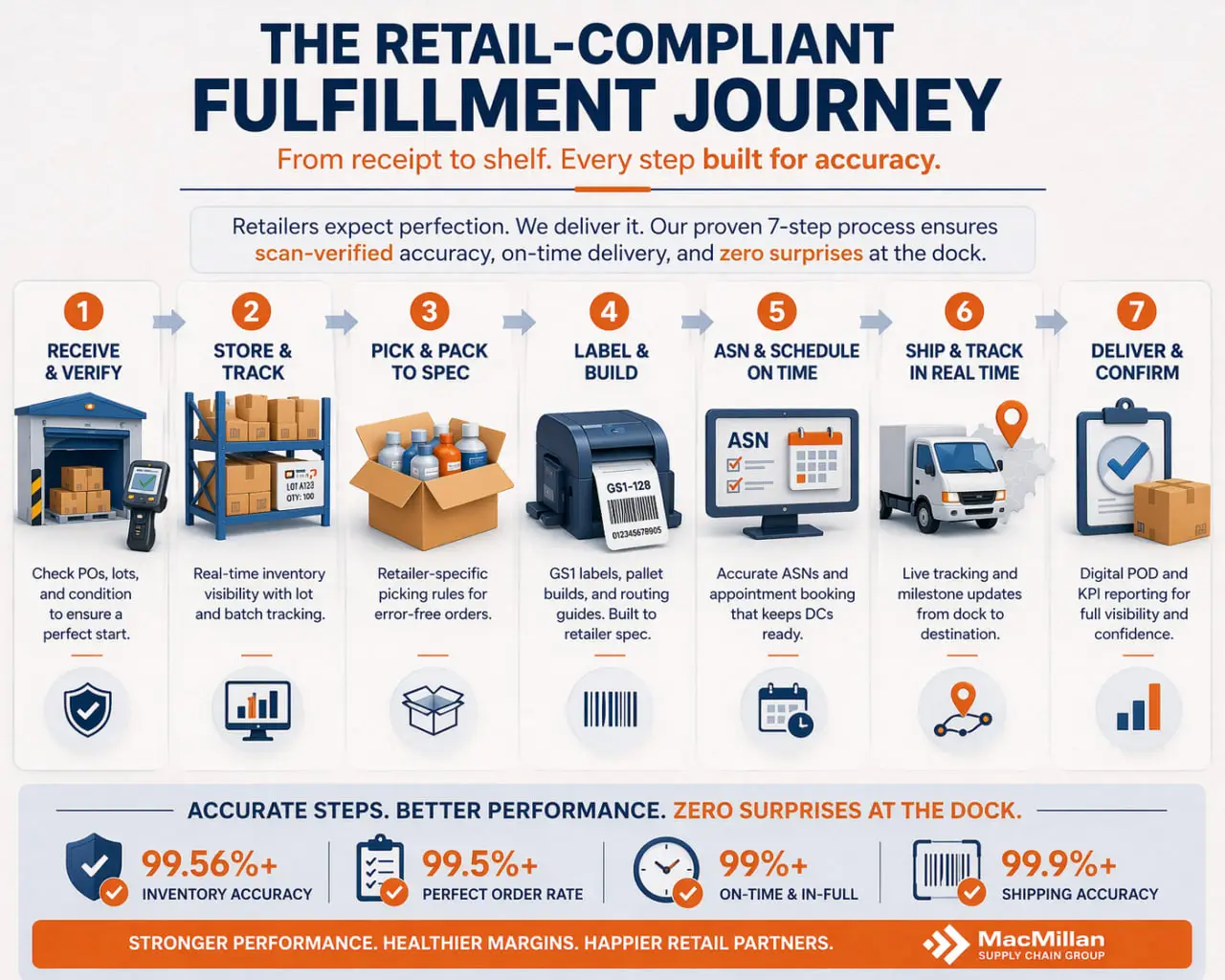
Chargeback prevention starts when goods enter the warehouse. Inventory verification, exception logging, and ASN or PO matching during receiving help stop downstream errors before they reach a retailer. Evolution Fulfillment’s Canadian warehouse guidance explicitly notes that early-step receiving accuracy helps prevent chargebacks and inventory mismatches.
Every retailer has its own routing guides, packaging rules, scheduling requirements, and compliance details. Your warehouse and transportation workflows need retailer-specific execution, not one generic process for all orders.
If your team tracks only shipped orders, you are missing the metrics retailers care about. OTIF and fill rate expose the gap between “we shipped it” and “the retailer received it exactly as expected.” Shopify’s current guidance suggests mature companies often aim for 95%–98% OTIF and at least 95% fill rate on core stocked items.
Weak visibility causes mispicks, stockouts, rushed substitutions, and last-minute errors. Real-time inventory tracking and order visibility help teams catch problems before a shipment is staged.
Compliance does not end at pick and pack. It continues through appointment scheduling, route planning, dispatch accuracy, milestone updates, and proof of delivery. Retail-ready fulfillment needs tight coordination between warehouse execution and final-mile or linehaul performance.
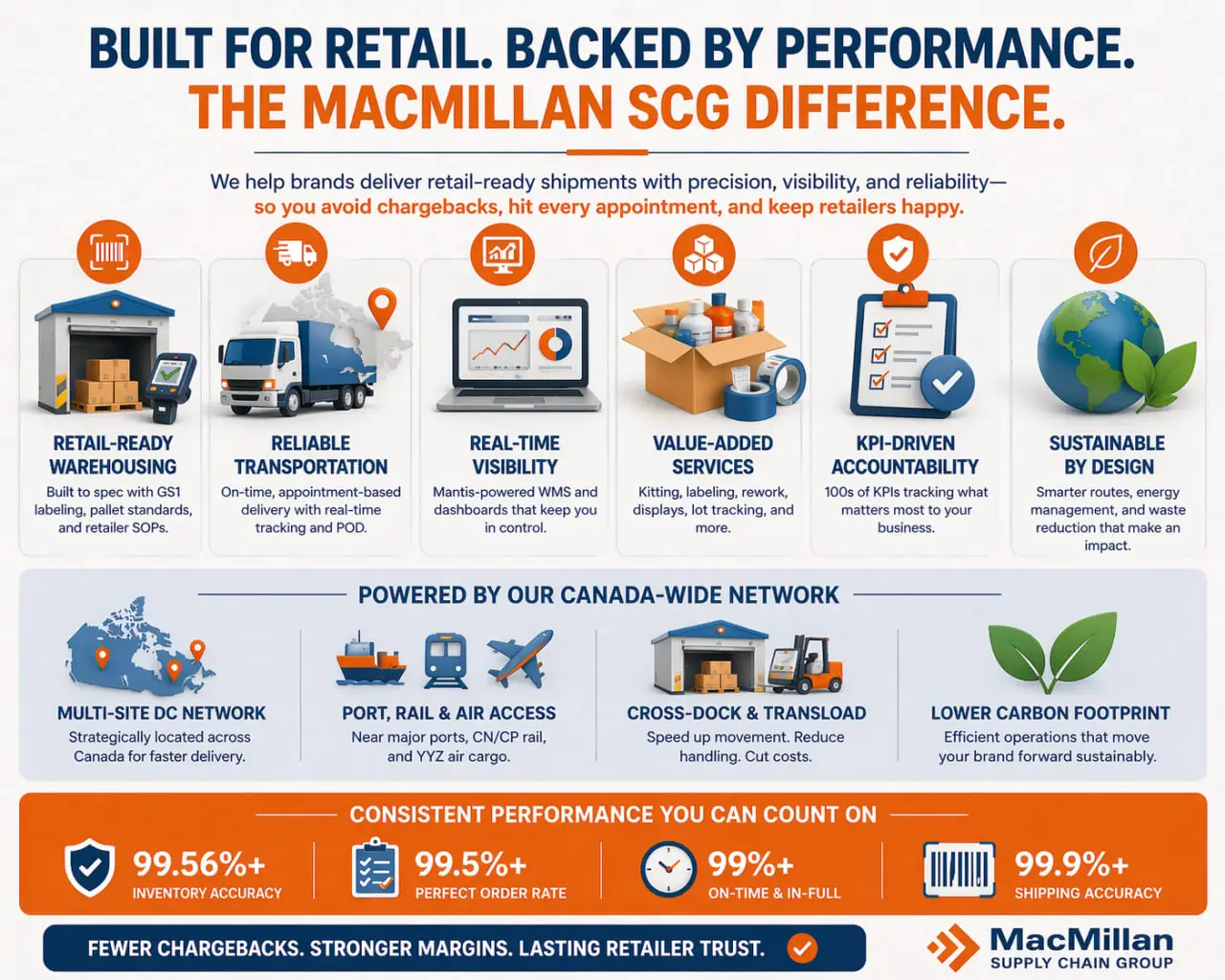
MacMillan SCG is positioned around exactly the capabilities brands need to reduce chargebacks and delivery rejections: retail-compliant warehousing, transportation built for FMCG velocity, real-time visibility, and value-added services that support promotional readiness and channel-specific execution. According to MacMillan’s site, the company supports warehousing and distribution, transportation and logistics, ecommerce fulfillment, and value-added services under one roof, with multi-site distribution capabilities across Canada.
Here is how that translates into chargeback prevention:
MacMillan’s warehousing service is designed for retailer requirements including pallet height, label requirements, carton orientation, and ASN accuracy, helping brands reduce chargebacks and delivery rejections before orders leave the building. The company also supports FEFO, FIFO, lot and batch tracking for better control and compliance.
MacMillan’s value-added services include GS1 barcodes, bilingual packaging, retailer-specific labeling, kitting, display assembly, promo stickers, reconfiguration, and lot or expiry tracking. That is especially valuable for product launches, seasonal promotions, bundled offers, and multi-channel campaigns where compliance errors often increase.
MacMillan states that its transportation network is built for just-in-time deliveries, promotional drops, and strict retail DC schedules, with real-time tracking, milestone updates, and digital PODs for better shipment control and transparency.
MacMillan publishes KPI-led positioning across its site, including 99.56% inventory accuracy, 99.5% perfect order rate, 99% shipments on time and in full, and 99.9% shipping accuracy on its KPI comparison page. For a brand evaluating chargeback risk, these are the kinds of operating signals that matter.
A strong retail fulfillment process usually includes:
That structure mirrors what is working in strong competitor content as well. The best-performing posts are not vague. They walk buyers through the operational path from error prevention to measurable results.
Brands searching “reduce retail chargebacks” or “delivery rejections retail compliance” are not in early awareness mode. They are usually feeling pain already. That makes this a strong bottom-to-middle funnel topic because it attracts operations leaders, supply chain managers, ecommerce directors, and founders looking for a fix.
This is also why the headline works. Competitors are getting more traction from practical, consequence-led titles like “how to overcome retailer challenges,” KPI-based guides, and cost-comparison content. A high-CTR headline in this space needs three things:
Retail chargebacks are rarely random. They are usually the visible cost of weak compliance, low visibility, or disconnected execution between warehouse and transportation.
Brands that want to reduce penalties, improve OTIF, and protect retailer relationships need a 3PL partner that can execute to spec every time, not just move freight from one point to another.
MacMillan Supply Chain Group helps brands stay retail-ready with compliant warehousing, channel-specific labeling, promotional support, real-time visibility, and transportation built for precision. If your team is dealing with recurring chargebacks, rejected deliveries, or retailer scorecard pressure, this is the moment to fix the process behind the problem.
Talk to MacMillan SCG about building a retail-compliant fulfillment workflow that reduces chargebacks, protects margins, and keeps your products moving from dock to shelf with confidence.